How to bill Ohio BWC
vocational rehabilitation.
For BWC-enrolled vocational rehabilitation case managers. You do not bill BWC. You bill one of nine MCOs, in W-codes, in tenths of an hour, on a CMS-1500 that holds six lines, by fax, with your tracking log behind it — and you have a year to do it. Here is the whole chain, in the order it actually happens.
The payer is the MCO, not the Bureau.
Ohio is one of four monopolistic states: employers buy coverage from the Bureau of Workers’ Compensation and there are no private carriers. But BWC hands the medical and return-to-work side of every state-fund claim to a private Managed Care Organization, and the MCO is who authorizes your services and pays your bills.
Nine MCOs are currently certified. The employer picked one; the claim carries it; you bill whichever one is on the claim in front of you:
CorVel (CorVel Ohio) · MinuteMen (OhioComp) · OHL (Occupational Health Link) · 3-hab, Ltd. · AultComp · ProMedica (formerly HMS) · Spooner MAI · Sedgwick MCO · Sheakley UniComp
Phone and fax for all nine are on our Ohio MCO directory. Two of them — Sedgwick and CorVel — are national third-party administrators wearing an Ohio-only hat, which is worth knowing if you ever bill outside Ohio and meet the same names as TPAs.
One quiet fact that changes the tone of the work: vocational rehabilitation is paid from BWC’s surplus fund, so your bills do not hit the employer’s premium experience. You are billing a published state fee schedule through an intermediary, not arguing with an employer over every dollar.
Enrollment, then a plan, then an authorization. In that order.
Nothing unauthorized gets paid, and no amount of good documentation fixes it afterwards. The sequence is the billing system.
- Be an enrolled, credentialed BWC provider. Vocational rehabilitation has its own credentialing requirements — BWC publishes them as a requirements document for providers of vocational rehabilitation services. Your BWC provider number is what the MCO pays against.
- Referral and feasibility. Anyone can refer; BWC and the MCO decide eligibility, and the injured worker’s participation is voluntary.
- Assessment and a written plan. The assessment report (RH-42) and the comprehensive plan (RH-44 / BWC-3012) are the artifacts. The individualized written plan is a rule, not a courtesy — see OAC 4123-18-05.
- Authorization. The MCO authorizes specific service codes, a number of units, and a date range (the RH-45 is the request). Bill a code that is not on the authorization, or units past the ones granted, and the line comes back unpaid — this is the single most common Ohio denial that is entirely inside your control.
- Implementation and monitoring. Progress reports (RH-46), job-search contact logs (RH-10), employer contacts, the employment specialist — each one a timed, coded activity you will bill.
Ohio also carries case types — standard BWC claims plus JR, SI and RAW — and a complexity level of 1, 2 or 3 on the case. The case type decides which code family you are in; the level decides the rate. Neither is yours to choose at billing time, and both are worth writing on the front of the file, because getting one wrong is invisible until the remittance arrives.
What the W-codes pay, and the two meanings of “unit”.
Rates are set by rule — OAC 4123-18-09, the vocational rehabilitation fee schedule — and BWC updates them every October. The plan-implementation family is leveled: the bare code bills Level 1, the same code with W2 on the end bills Level 2, and there is a third level above that.
| Code | What you are billing | Level 1 | Level 2 (W2) |
|---|---|---|---|
| W3207 | Phone call or email | $81.90 | $84.40 |
| W3220 | Documentation review | $81.90 | $84.40 |
| W3230 | Plan and authorization request writing | $81.90 | $84.40 |
| W3235 | Report writing | $81.90 | $84.40 |
| W3007 / W3017 / W3020 / W3025 | Pre-plan and assessment — no level | $91.00 | — |
Rates are per hour of your time, billed in tenths. October 2025 schedule. Current as of July 2026 — verify with Ohio BWC.
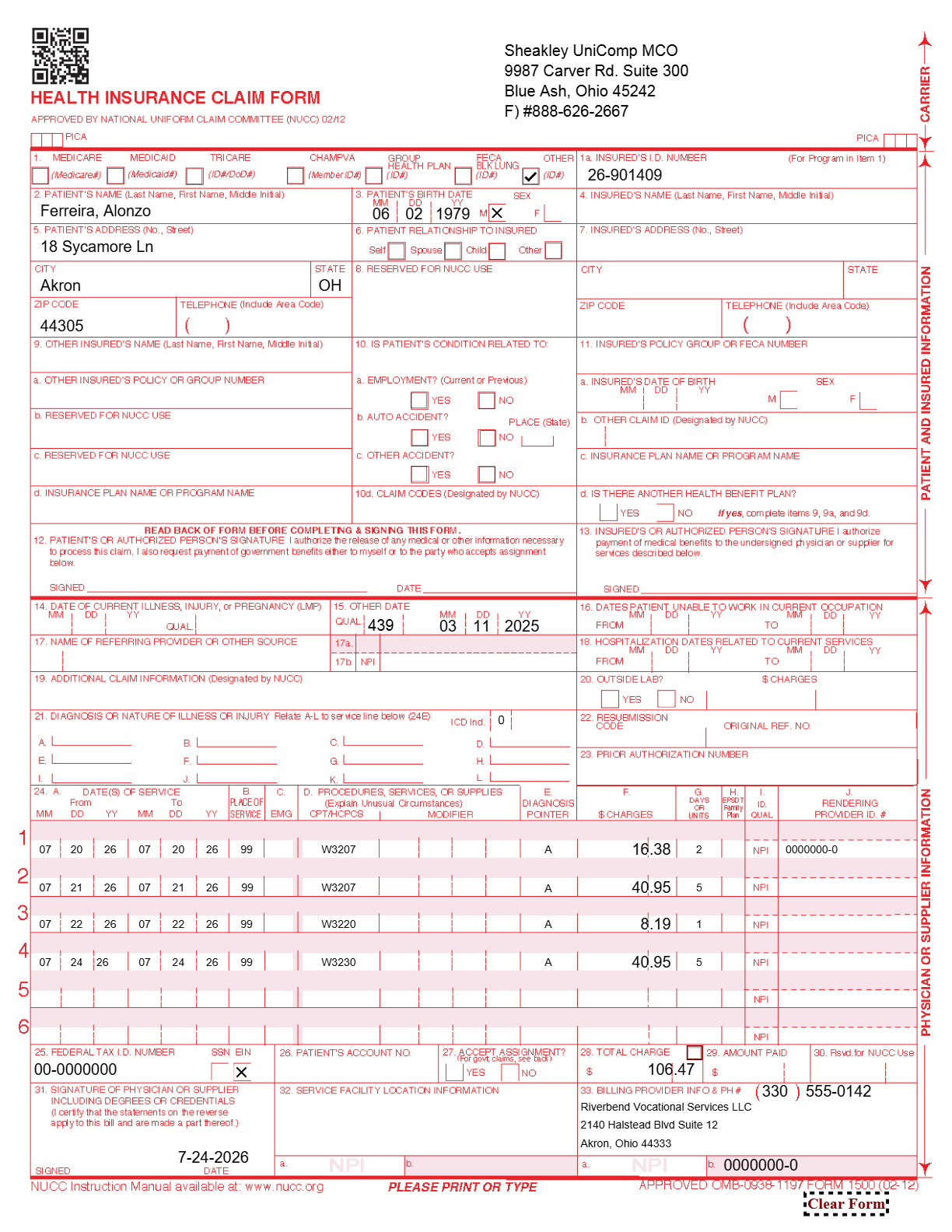
This is where Ohio bills go wrong quietly. The schedule figure is the hour. The form counts tenths. Twelve minutes is 0.2 — two units, $16.38. Half an hour is five units, $40.95. A full hour is ten units, $81.90.
Count-based codes are not multiplied: 23 miles of mileage is 23 in box 24G, never 230. Time × 10, counts as themselves. Mixing those up is the most common self-inflicted short-pay in Ohio voc rehab.
The full table, including the W3 level and the rest of the family, is on our W-code reference.
Six service lines. Your week had nine.
Ohio voc rehab bills on the CMS-1500, the same professional claim form a physician uses — carrying W-codes instead of CPT, and faxed to an MCO instead of sent to a health plan.
Box 24 holds six service lines. A busy week on one claimant does not fit, so the bill overflows onto a second form and sometimes a third — the “B” and “C” forms. Three rules that save arguments later:
- Each form is its own bill. Give each one its own row in your receivables, or the MCO pays form A, you tick the claimant off, and forms B and C sit unpaid for a year.
- Keep the date order the same on the form as in your log. A reviewer comparing your narrative to your claim form should not have to sort anything.
- Units in box 24G, not minutes. Six minutes is a 1. Our line splitter shows exactly how a given number of lines breaks across forms.
The report travels with the bill.
In Ohio the narrative is not a separate deliverable you get to do later. The weekly client tracking log goes behind the claim form in the same fax, and the RH-series reports are what the MCO reads when it decides whether the units you billed look like the work you described.
What a defensible log entry has, every time: the date, the code, the units, and a note with the actual time range and who you spoke to. “Rec’d/rev’d ES notes” with a six-minute bracket and W3220 beside it survives an audit. “Case management” does not.
Keep the RH-10 job-search contact logs with the file too. When an MCO questions plan progress it is the contact log, not your invoice, that answers.
Fax it. Then file the confirmation.
Fax is still the first-class channel to Ohio MCOs — there is no provider e-billing mandate here. The confirmation page is not paperwork; it is your evidence.
BWC allows one year to file. A year sounds generous until a plan runs eight months and the bill for month two is the one nobody sent. The discipline that costs nothing: fax the packet, file the confirmation into that claimant’s folder the same day, and treat the folder as the record of what left the building. See timely filing for what that clock is doing.
One MCO check. Sixteen claimants. Three of them short.
The gap on line eleven — small enough to look like rounding, on a check that covered sixteen people.
Ohio payment does not arrive bill by bill. An MCO pays a batch, so a single check covers many claimants at once and you allocate it line by line against what you billed.
In our first customer’s anonymized book, three of the nine MCOs carried nearly all of a week’s billings — roughly 65%, 19% and 15%. That concentration is what makes the one-check-many-claimants problem the defining Ohio receivables headache: most of your money arrives in a handful of large, multi-claimant payments, and a $16.14 gap on line eleven looks exactly like a rounding difference until you add up a year of them.
What to do about it, in order: compare every paid line to the billed line, not the total. Flag the gap in dollars. Keep the original form attached to the flag so the rebill is a resend, not a reconstruction. Then rebill inside the year. Our short-pay calculator does the first two steps for a single check if you want to see the size of the pattern before you build a system for it.
The rates move, and your history should not.
BWC updates the vocational rehabilitation fee schedule each October. New work bills at the new rate. Work you already performed keeps the rate that was in force on the date of service — that is how an audit expects to find it, and it is why a spreadsheet with one hard-coded rate column quietly becomes wrong every autumn.
If you are rebilling a short-paid line from before the change, bill it at the rate that applied on the date of service, not today’s.
What we have not told you, and where to get it.
Level 3 rates, travel, wait time, mileage and outcome payments. They are real codes on the same schedule, priced on different bases — per mile, per case. We would rather send you to the rule than print a number you then bill from: OAC 4123-18-09, Appendix.
Per-MCO quirks. Each MCO has its own habits about cover sheets, attachments and who to call about a denial. There is no published master list of those, and anyone who tells you there is has made it up.
The full procedural rulebook. BWC’s Provider Billing & Reimbursement Manual, Chapter 3 is the vocational rehabilitation chapter and is the document to keep open beside this one.
You will type each of these activities four times.
Not because you are disorganized. Because nobody ever built software for this job, so the job got done in Excel and Word — and those four files do not talk to each other.
One activity, four keystrokes-worth of work, four separate files. Thirty to forty of them a day. That is the four to eight hours our first customer spent on paperwork before she typed each activity exactly once and let the log, the tracking log, the claim forms and the receivable build themselves.
Med Claims Pro is configured to your formats, folders, payers and codes during onboarding — included in every plan. See how Ohio billing maps onto it, or book fifteen minutes and watch a week like yours run itself.
Questions, answered.
Do I bill BWC directly?
No. On a state-fund claim you bill the injured worker’s MCO — one of the nine certified Managed Care Organizations. The MCO authorizes the services and pays the bill; BWC funds it from the surplus fund.
How long do I have to file?
BWC allows one year. The fax confirmation you file the day the packet goes out is what proves you made it, which is why the confirmation belongs in the claimant’s folder rather than in a fax machine’s memory.
What is the difference between W3207 and W3207W2?
The level. The bare code bills Level 1 at $81.90 an hour; the W2 suffix is the same activity on a Level 2 case at $84.40. The level belongs to the case, not to the activity — which is why billing the wrong variant is an underpayment nobody at the MCO will correct for you. Rates current as of July 2026; verify with Ohio BWC.
How many units is a 25-minute call?
Round to the tenth of an hour your practice uses consistently: 0.4 is 24 minutes, 0.5 is 30. On the form it prints as a 4 or a 5 in box 24G, and the charge is 4 × $8.19 or 5 × $8.19 at Level 1.
My week does not fit on one CMS-1500.
It is not supposed to. Six service lines per form, then a B form, then a C form. Give every form its own receivable row — the classic Ohio loss is form A getting paid, the claimant getting ticked off, and forms B and C aging quietly to the one-year line.
Can I e-bill an Ohio MCO?
Fax and paper remain first-class in Ohio and there is no provider e-billing mandate. Direct electronic billing to mandate states elsewhere is on our roadmap and is not a shipped feature of Med Claims Pro today.
See your own week run itself.
We load your state’s codes before the call, so you are looking at a caseload like yours inside the first two minutes — not a slide deck.