Oregon vocational assistance billing —
Bulletin 124 caps, counted down.
OAR 436-120 and Bulletin 124 set the category caps you work inside — $779 for an eligibility evaluation, $10,430 for direct employment — and SAIF is roughly half the market. Forms 1880 and 2800 travel with the work; the arithmetic travels with you.
The facts, before the pitch.
How billing works in Oregon
- Who you bill
- The carrier.
- What you send
- Invoice against category caps.
- The channel
- Direct; payers must accept e-bills.
- Fee basis
- OAR 436-120 and Bulletin 124 category caps.
- The clock
- Not a deadline we have verified for Oregon. Ask the Oregon Workers' Compensation Division (WCD), and read the payer’s own contract, before you rely on a date.
The system. Certified counselors at registered vocational-assistance providers, working to category caps.
Where the rules are written. OAR 436-120; Bulletin 124 (rev. 5/2026).
The paperwork with its own name. Form 1880 · Form 2800.
Electronic billing. Payers must accept e-bills. Med Claims Pro builds the bill and the packet and files the confirmation; direct electronic submission is roadmap, not a shipped feature.
Configured for Oregon during onboarding — see it with your caseload. Your rates, your forms, your payers and your folder names are set up in your first week, included in every plan. What is on this page is what we would configure; we have not claimed a single Oregon customer anywhere on it.
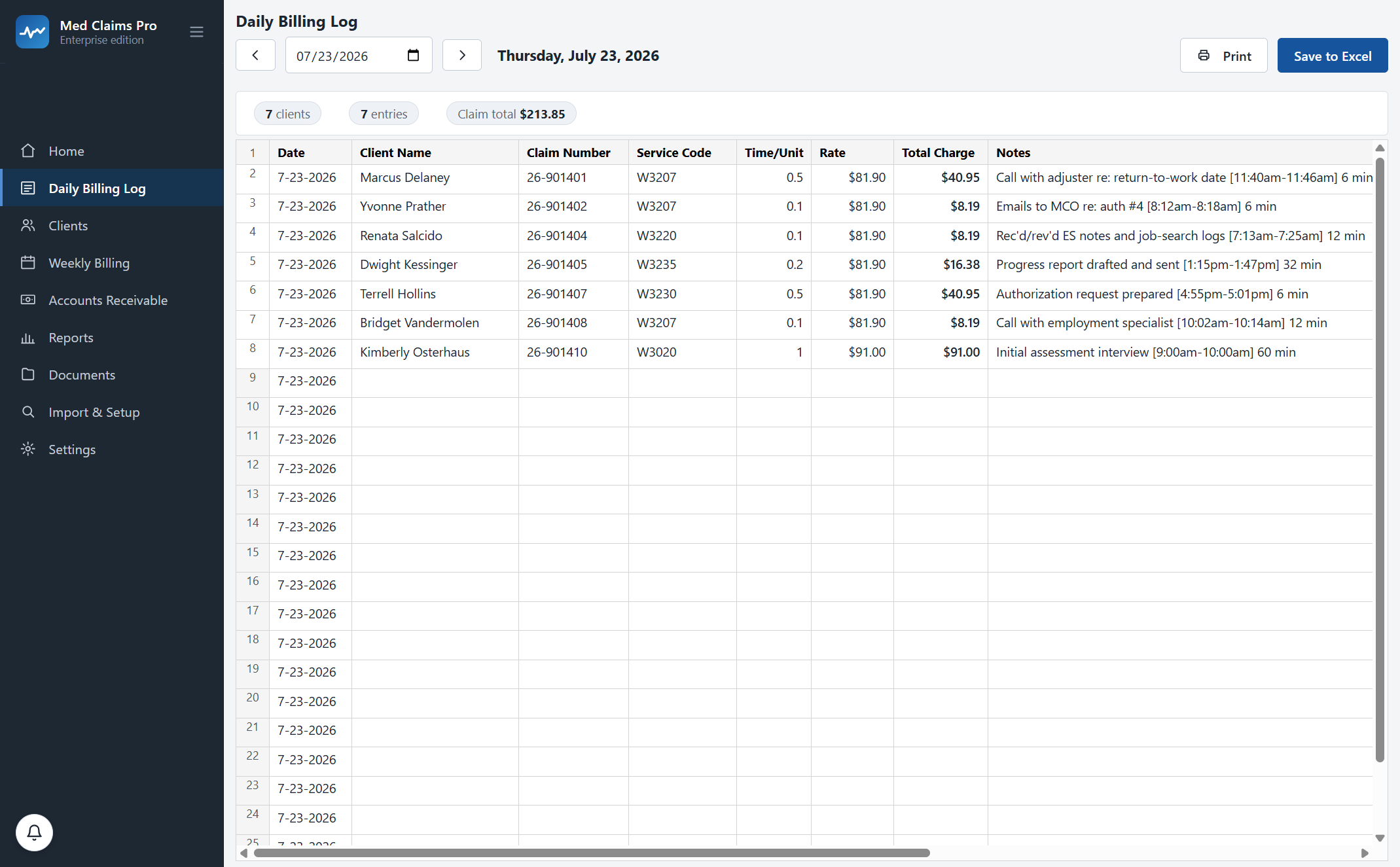
Your week, in Oregon’s documents.
Every category has a ceiling, and the only thing between you and the ceiling is addition you do by hand.
- 8:25 a.m.Eligibility evaluation interview and records review.Filed to the eligibility category, so the $779 ceiling starts counting down from the first entry.
- 11:10 a.m.Direct employment work: two employer contacts and a placement call.Different category, different ceiling. The software keeps them apart so the remainder means something.
- 2:00 p.m.Form 1880 paperwork and a note to the insurer.Recorded once, in your template, and reused wherever the same words are needed again.
- 4:45 p.m.Invoice against the category, with the remaining balance visible before you send it.Not after. Before.
Every one of those rows is typed once, as it happens. The daily log writes itself as you go, the weekly narrative log builds in your own Word template, a CMS-1500 fills with the right units and the right payer block where a payer wants one — and where your state bills on its own form or an invoice, the dated, timed, priced lines that go on it come off the grid, and the receivable is tracked from the moment the bill leaves. The whole chain →
Bulletin 124 category caps.
| Service category | Cap |
|---|---|
| Eligibility evaluation | $779 |
| Direct employment | $10,430 |
Current as of July 2026 — verify with the Oregon Workers' Compensation Division (WCD).
Bulletin 124 was revised in May 2026 and carries far more categories than the two shown here; these are the headline figures. Confirm the full schedule with the Oregon WCD before you plan a case around it.
Rates move. When they do it arrives as a data update, and every activity you already billed keeps the rate it was billed under — which is the only way a rate change survives an audit.
A category cap is a budget written by somebody who will not remind you about it.
Oregon prices vocational assistance by category rather than by the hour, which is a sensible system right up until you are two-thirds through a direct-employment case with no running total.
The software does not hold those category caps today — there is no authorized / used / remaining figure in it. What it holds is every entry, dated, coded, priced and attached to its claimant as you type it, so the running total is arithmetic over records that already exist rather than something you reconstruct from a calendar at the end.
SAIF is about half of this market, and the private carriers are the rest. Both age in the same receivables list, so you can see which one is slower without believing anyone’s reputation.
Who pays you in Oregon.
SAIF, the state fund, is roughly half of Oregon’s market; private carriers carry the rest. Payers here must accept electronic bills, which shapes their format expectations more than it shapes yours.
Oregon payers
- SAIF (≈half the market)
- Private carriers
National carriers you will meet
- Travelers
- The Hartford
- AmTrust
- Zurich
- Chubb
- Berkshire Hathaway
- Liberty Mutual
- AF Group / Accident Fund
- Old Republic
- Great American
TPAs that send the referrals
- Sedgwick
- Gallagher Bassett
- ESIS
- Helmsman
- Broadspire
- CorVel
- TRISTAR
- CCMSI
- Athens Administrators
One check, many claimants. Whichever of these names is on the envelope, the check covers a dozen files at once. You record it once, tick the bills it pays, and anything short is flagged with the exact gap and the original form attached, ready to rebill. How that screen works.
Billing addresses and submission preferences go stale faster than any page can keep up, so we publish them only where we keep them current — today that is Ohio’s nine MCOs. Your Oregon payers and their submission preferences get set up during onboarding, from your own files.
Where the rules actually live.
Ask the Oregon Workers' Compensation Division (WCD) for
- the current text of OAR 436-120; Bulletin 124 (rev. 5/2026)
- blank copies of Form 1880, Form 2800
- the current OAR 436-120 and Bulletin 124 category caps
We have not published a verified link set for Oregon yet, and we would rather send you nowhere than somewhere out of date. If you have the current documents, send them over — admin@onservice.us.
How we keep this page honest
Every fact above is transcribed from the Oregon Workers' Compensation Division (WCD) or the statute named, dated July 2026, and reviewed when the agency republishes. Where we have not verified something we say so rather than filling the gap.
Found something out of date? Tell us and we will fix it the same week: (302) 202-3172 or admin@onservice.us.
See an Oregon caseload run itself.
Fifteen minutes, Oregon’s codes on screen, with a caseload that looks like yours. Or start the trial and poke around on your own — no card, no contract.
There is a phone number and a person answers it: (302) 202-3172.
States that work like Oregon
Questions, answered.
Can it count down a Bulletin 124 category cap?
Yes — authorized, used and remaining per category, per claimant, updated as you enter work rather than as you invoice it. That is the whole point of the grid in a capped state.
Are the caps on this page the full list?
No. Bulletin 124 has many more categories; the eligibility evaluation at $779 and direct employment at $10,430 are the headline figures. Current as of July 2026 — verify with the Oregon WCD, which revised the bulletin in May 2026.
Do you handle Forms 1880 and 2800?
The billing and documentation chain around them, yes; the forms themselves are configured during onboarding from your own copies, because agency forms get revised and yours are the current ones.
Oregon payers must accept e-bills. Do you send them?
No. We build the bill and the packet and file the proof; direct electronic submission is on our roadmap. Nothing on this site describes it as shipped.
Does SAIF bill differently from the private carriers?
In practice every payer has preferences, which is what onboarding configures. In reporting they are just two payer rows, each with its own billed, paid, owed and aging.
See your own week run itself.
We load your state’s codes before the call, so you are looking at a caseload like yours inside the first two minutes — not a slide deck.