You searched for a code,
not for software.
For VRCs, VRCMs, QRCs, rehabilitation suppliers, court-certified counselors and workers’-comp nurse case managers. The code, the rate, the form number, the fee schedule, the filing clock, and where the bill actually goes — faxed to an MCO in Ohio, through My L&I in Washington, under an e-billing mandate in Minnesota and North Carolina — 6 state billing guides, 28 glossary entries, four calculators and 51 jurisdiction pages, written for someone who bills a workers’-comp payer for her time.
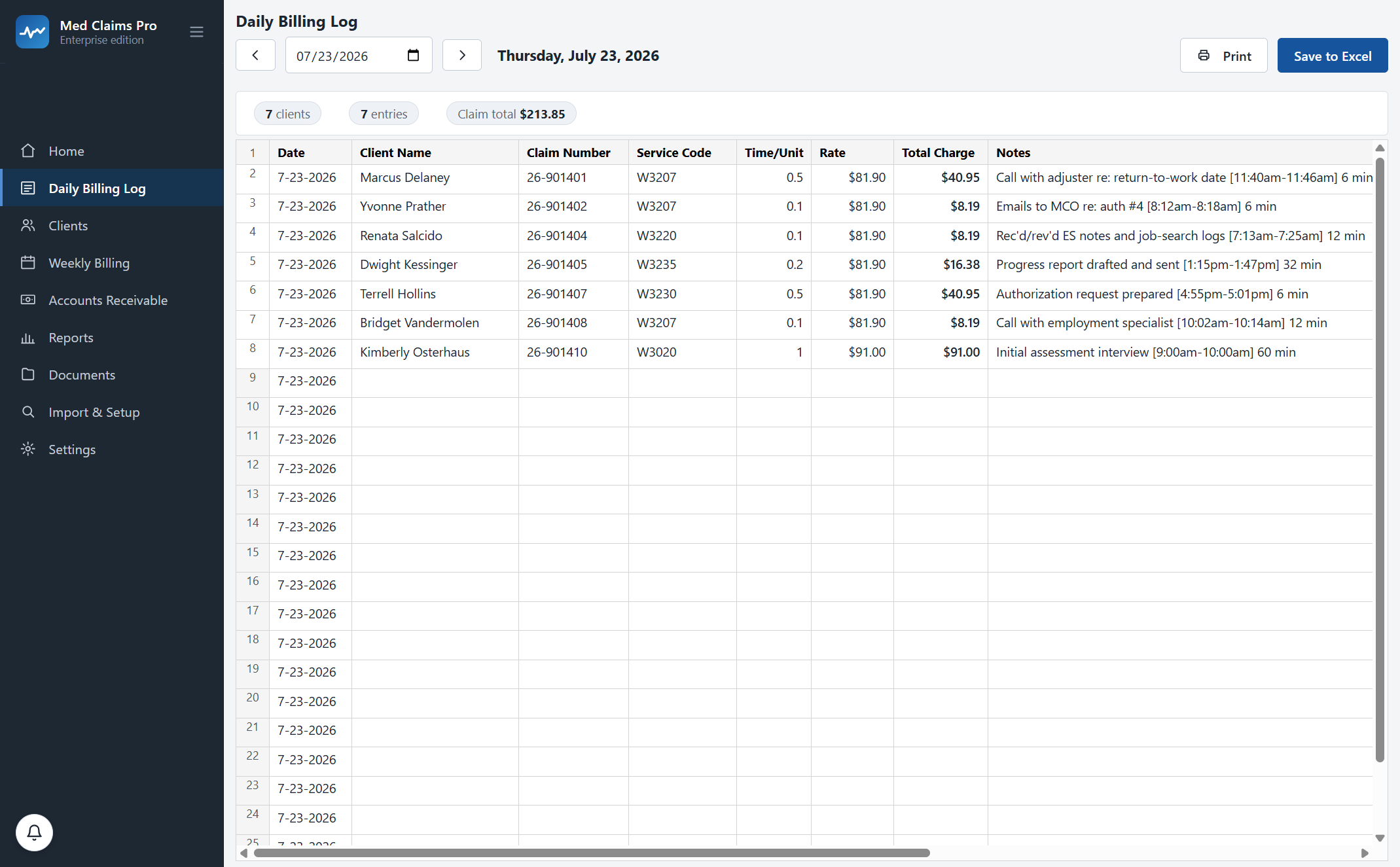
Four kinds of thing, all of them free.
State billing guides
The long answer to “how do I bill voc rehab in my state” for the 6 states with real private markets — Ohio, Washington, Minnesota, Georgia, North Carolina and Nebraska. Enrollment, authorization, the code set or the hourly rate, the form, the channel, the clock, and what to do when the check comes short.
The glossary
28 terms defined for the person holding the remittance: EOR, short-pay, auth burn-down, W3235W2, Form 25N, MARFS Chapter 25, one check many claimants. What it is, why it matters to your Friday, and where to go next.
Free tools
Four calculators that run in your browser and send nothing anywhere: the short-pay gap, the CMS-1500 line split, what your own retyping hours cost across a year, and your state’s filing clock. Plus two printable references we send by email.
Every state, and DC
51 jurisdiction pages: who you bill, on what form, through what channel, on what fee basis, under what clock — with the agency named and the unverified parts marked as unverified rather than smoothed over.
The flagship state has its own reference shelf.
Ohio is where the software was built, so it is where the references go deepest. Both of these are ungated, and both carry the month they were verified.
W-codes and current rates
W3207, W3220, W3230, W3235 with their Level 1 and W2 rates; the non-leveled W30xx assessment set at $91.00; and the arithmetic that turns six minutes into a “1” in box 24G. October 2025 schedule — verify with Ohio BWC.
The nine MCOs
Phone and fax for every BWC-certified Managed Care Organization, with the parent company and lineage — because “who do I actually send this to” is a real question with a real answer that nobody publishes in one place.
The full Ohio billing guide → · Ohio, mapped onto the software →
Because you can check our arithmetic before you check our software.
There is a version of this website that hides the rate tables behind an email box. We think that is a bad trade for both of us: you get another newsletter, and we get a lead who has not yet seen whether we know anything.
So the codes, the rates, the rule numbers and the filing clocks are all on the page — and the payer fax numbers where we can keep them current, which today means Ohio’s nine MCOs. Two printable references — the W-code cheat sheet and the tracking-log template — are sent by email, and their pages say so plainly instead of looking like a download and turning into a form.
Everything here follows the same three rules. Facts carry the month we verified them and the agency to verify them against. Where our research did not establish something — Nebraska’s rates, North Carolina’s market rates, Massachusetts’ current rate exhibits — the page says so rather than guessing. And nothing is claimed for the software that it does not do today: direct e-billing to mandate states is on the roadmap, and it is labeled roadmap everywhere.
Found something that is wrong? Call (302) 202-3172 or email admin@onservice.us. Being corrected is a much better outcome than being quietly wrong in front of a profession where everyone knows everyone.
The reference pages describe the job. The product does it.
Every rate rule, overflow rule and filing clock in this library is something the software applies to every bill without being asked. If you have read a guide and thought “this is four documents of retyping”, that is the part we sell — each activity typed once instead of into four files.
And the parts no reference page can cover — your Word tracking-log template, your folder names, your payers, your rate agreements, the way you write a time bracket — are configured to your practice during onboarding, in your first week, included in every plan. Every practice bills a little differently; that is the part we set up rather than the part you adapt to.
Questions, answered.
Do I have to give you an email address to read any of this?
No. The guides, the glossary, the state pages, the Ohio references and the four calculators are all open. Two printable items — the W-code cheat sheet and the tracking-log template — are sent by email, and their own pages say so before you click.
How current are the rates and rules?
July 2026, with the agency named on every figure. Fee schedules move on their own cadences — Ohio BWC updates in October, Washington L&I in July, Minnesota indexes annually — so verify with the agency before you bill from a number on any website, ours included.
My state does not have a guide. Is there anything for me?
Yes: a state page with the same discipline — who you bill, on what form, through what channel, on what fee basis, under what clock. In states where the voc-rehab benefit was repealed or is delivered by a state agency, the page says so plainly, and invoice-based nurse case management billing works there today.
Can I share these with colleagues?
Please do. There is no signup wall to send them through, and a page that gets forwarded around an IARP chapter is worth more to us than a gated PDF nobody opens.
See your own week run itself.
We load your state’s codes before the call, so you are looking at a caseload like yours inside the first two minutes — not a slide deck.