Ohio BWC vocational rehab billing,
from daily grid to paid claim.
You bill an MCO, not BWC — in W-codes, in tenth-of-an-hour units, on a CMS-1500, by fax, with the tracking log stapled behind it. Med Claims Pro was built inside a working Ohio voc-rehab practice, and it does that exact paper trail from one daily grid.
The facts, before the pitch.
How billing works in Ohio
- Who you bill
- The injured worker’s MCO — one of nine BWC-certified Managed Care Organizations.
- What you send
- CMS-1500, W-codes, six service lines per form (a busy week overflows onto B and C forms).
- The channel
- Fax to the MCO. Keep the confirmation — it is your timely-filing proof.
- Fee basis
- OAC 4123-18-09 fee schedule, unit-priced in tenths of an hour (0.1 unit = 6 minutes).
- The clock
- One year to file (BWC timely filing).
The system. State fund with nine private MCOs managing the medical side of every claim.
Where the rules are written. Ohio Administrative Code 4123-18-09 (fee schedule); OAC 4123-18-05 (the individualized written plan).
The paperwork with its own name. RH-42 assessment report · RH-44 / BWC-3012 comprehensive plan · RH-45 authorization request · RH-46 progress report · RH-10 job-search contacts.
Voc-rehab services are paid from BWC’s surplus fund, so your bills never hit the employer’s premium experience.
Electronic billing. Fax and paper remain first-class; no provider e-billing mandate. Med Claims Pro builds the bill and the packet and files the confirmation; direct electronic submission is roadmap, not a shipped feature.
Available for Ohio. The codes, the forms, the payers and the fee basis on this page are what the software is set up to run — and onboarding fits it to your templates, your folders and your filing names in the first week.
Your week, in Ohio’s documents.
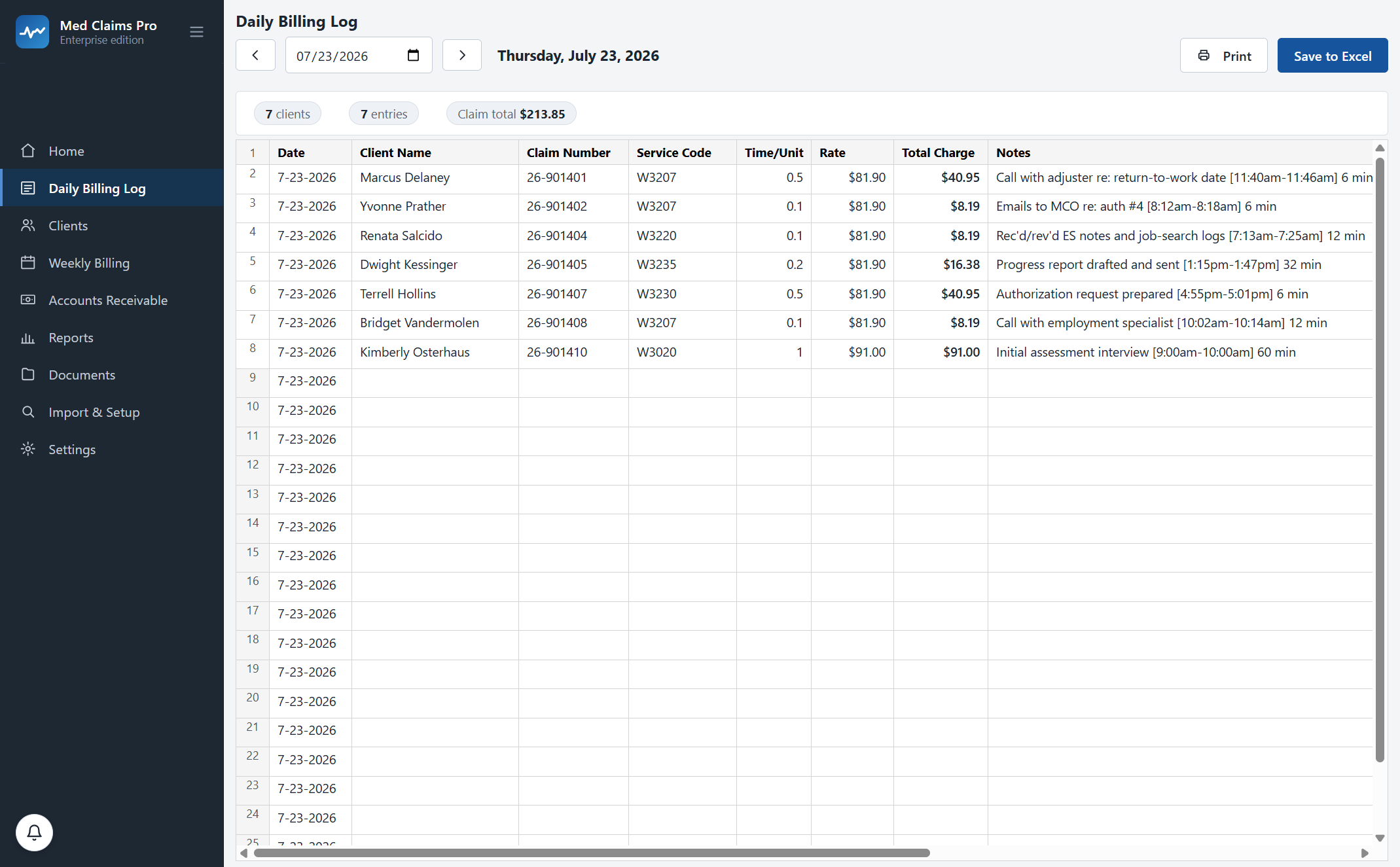
Thirty to forty coded, timed entries a day, each one worth six minutes and a rate — and every one of them typed four times before anybody gets paid.
- 7:13 a.m.Rec’d/rev’d ES notes. Six minutes. W3220.One row: 0.1 units at $81.90, the claim number, the level and the MCO already attached.
- 10:02 a.m.Two emails to the MCO about auth #4. W3207.The running total for that claim moves as you type. No separate spreadsheet to reconcile on Sunday.
- 1:40 p.m.Progress report, thirty minutes. W3235.Three units. The note keeps its time range, in your bracket style, and lands in the weekly log.
- 3:25 p.m.RH-10 job-search contacts reviewed with the employment specialist.Filed to the client, the week and the plan — where an audit would look for it.
- 9:00 p.m.The second shift: daily log, Client Tracking Log, the CMS-1500 — the sixth line fills and a B form starts — then the Bill Tracker.Deleted. The Word log builds in your template, the form fills with 0.1 written as “1”, the W2 suffix at $84.40, the right MCO header, and splits to B and C on its own.
Every one of those rows is typed once, as it happens. The daily log writes itself as you go, the weekly narrative log builds in your own Word template, the claim form fills with the right units and the right payer block, and the receivable is tracked from the moment the bill leaves. The whole chain →
W-codes: an hourly rate, billed in six-minute units.
| What you bill | Rate |
|---|---|
| W3207 / W3220 / W3230 / W3235 — plan implementation, Level 1 | $81.90/hr — $8.19 per 0.1 unit |
| Same family at Level 2 ("W2" suffix) | $84.40/hr — $8.44 per 0.1 unit |
| W3007 / W3017 / W3020 / W3025 — pre-plan & assessment | $91.00/hr — $9.10 per 0.1 unit |
Current as of July 2026 — verify with the Ohio Bureau of Workers' Compensation (BWC).
BWC republishes the voc-rehab fee schedule each October. Level 2 codes carry the W2 suffix (W3207W2 and so on); mileage and outcome codes are counted, not timed, and go on the form as-is.
Rates move. When they do it arrives as a data update, and every activity you already billed keeps the rate it was billed under — which is the only way a rate change survives an audit.
One MCO check. Sixteen claimants. Three of them short.
You would catch it eventually — around 11 p.m., cross-referencing the EOR against the Bill Tracker. Med Claims Pro catches it the moment you record the check: every line compared to what you billed, every gap in dollars and cents, every rebill packet assembled with the original claim form attached.
Ohio pays voc-rehab services out of BWC’s surplus fund, so your bills never touch the employer’s premium experience — which is worth saying out loud to an employer who thinks a rehab plan will cost them. It does not change your filing clock: one year, and the fax confirmation in the client folder is what proves you made it.
How short-pay recovery works · The full W-code and rate table
Who pays you in Ohio.
Ohio is a monopolistic state fund, but you never bill the fund. Nine BWC-certified MCOs manage the medical side of every claim, the employer picks one, and that pick decides where your CMS-1500 goes.
Ohio payers
- CorVel (CorVel Ohio)
- MinuteMen (OhioComp)
- OHL (Occupational Health Link)
- 3-hab, Ltd.
- AultComp
- ProMedica (formerly HMS)
- Spooner MAI
- Sedgwick MCO
- Sheakley UniComp
National carriers you will meet
- Travelers
- The Hartford
- AmTrust
- Zurich
- Chubb
- Berkshire Hathaway
- Liberty Mutual
- AF Group / Accident Fund
- Old Republic
- Great American
TPAs that send the referrals
- Sedgwick
- Gallagher Bassett
- ESIS
- Helmsman
- Broadspire
- CorVel
- TRISTAR
- CCMSI
- Athens Administrators
One check, many claimants. Whichever of these names is on the envelope, the check covers a dozen files at once. You record it once, tick the bills it pays, and anything short is flagged with the exact gap and the original form attached, ready to rebill. How that screen works.
Payer fax numbers and billing addresses go stale faster than any page can keep up, so we publish them only where we keep them current. Today that is Ohio: all nine MCOs, with phone and fax.
Where the rules actually live.
Straight from the source
- BWC Provider Billing & Reimbursement Manual, Ch. 3 (Vocational Rehabilitation)
- Voc-rehab fee schedule — OAC 4123-18-09
- BWC Provider Look-up
- BWC MCO Report Card
Outbound links to the Ohio Bureau of Workers' Compensation (BWC). We do not mirror agency documents — the agency’s copy is the one that counts.
How we keep this page honest
Every fact above is transcribed from the Ohio Bureau of Workers' Compensation (BWC) or the statute named, dated July 2026, and reviewed when the agency republishes. Where we have not verified something we say so rather than filling the gap.
Found something out of date? Tell us and we will fix it the same week: (302) 202-3172 or admin@onservice.us.
See an Ohio caseload run itself.
Fifteen minutes, Ohio’s codes on screen, with a caseload that looks like yours. Or start the trial and poke around on your own — no card, no contract.
There is a phone number and a person answers it: (302) 202-3172.
States that work like Ohio
Questions, answered.
Can it match my exact folder names and Word templates?
Yes, and that is the point of onboarding. Your Client Tracking Log template, your folder tree, your file-naming convention and your payer list are configured in your first week, included in every plan. The documents land where your filing system already expects them.
Does it handle Job Retention, Self-Insured and Remain-at-Work cases?
Yes. The case type sets the code family and the rates, and the level suffix follows the plan — W3207 at $81.90 for Level 1, W3207W2 at $84.40 for Level 2. Current as of July 2026; verify with Ohio BWC.
What happens at the October rate change?
It arrives as a data update and you do nothing. New work bills at the new rate; everything you already billed keeps the rate it was filed under, which is what an audit expects to see.
My week has more than six service lines. What then?
The seventh line starts a B form on its own, and the thirteenth starts a C form. Each form gets its own receivable row, because that is exactly how the MCO checks come back. How overflow works.
I fax through RingCentral. Does that still work?
Yes — one click, from your own RingCentral account, with a cover sheet, and the confirmation files itself into the client’s folder. That confirmation is your timely-filing evidence for the one-year clock.
Is my client data on your servers?
No. Claims, notes and documents live in a database on your own computer and in your own folders, backed up on every launch. Our server holds your license and nothing else. The architecture.
See your own week run itself.
We load your state’s codes before the call, so you are looking at a caseload like yours inside the first two minutes — not a slide deck.