Kentucky workers’ comp case management billing —
when a judge orders it, and when nobody does.
Kentucky vocational rehabilitation happens when an administrative law judge orders it, which makes referrals rare and unpredictable. KEMI and the private carriers pay nurse case managers every week, and that is the work with a dependable rhythm.
The facts, before the pitch.
How billing works in Kentucky
- Who you bill
- The carrier or TPA.
- What you send
- CMS-1500 or invoice.
- The channel
- Direct.
- Fee basis
- No published rate we have verified. Ask the Kentucky Department of Workers' Claims before anyone quotes you one — including us.
- The clock
- Not a deadline we have verified for Kentucky. Ask the Kentucky Department of Workers' Claims, and read the payer’s own contract, before you rely on a date.
The system. Vocational rehabilitation is ordered by an administrative law judge; nurse case management is the live market.
Nurse case managers in Kentucky are supported today. Invoice-based case-management billing needs no state-specific setup — it works here now. Private vocational rehabilitation in Kentucky is a different story, told plainly further down, and there is a Kentucky voc-rehab list you can join.
Your week, in Kentucky’s documents.
Judge-ordered vocational work you cannot plan around, and case-management work you can.
- 7:50 a.m.Calls on three files before the drive east.Entered as they end, with claim numbers attached.
- 10:45 a.m.Appointment attended, wait time, 67 miles.Three lines, itemized as they happen.
- 1:50 p.m.Monthly report for a KEMI file.Written once, out of the weekly logs it already wrote.
- 4:20 p.m.Invoices out, receivables aging by payer.And Tuesday’s follow-up list already written.
Every one of those rows is typed once, as it happens. The daily log writes itself as you go, the weekly narrative log builds in your own Word template, a CMS-1500 fills with the right units and the right payer block where a payer wants one — and where your state bills on its own form or an invoice, the dated, timed, priced lines that go on it come off the grid, and the receivable is tracked from the moment the bill leaves. The whole chain →
A judge decides whether vocational rehabilitation happens on a Kentucky claim.
When vocational services depend on an administrative law judge’s order, referrals arrive without pattern. That makes a voc-rehab-first practice difficult to sustain here, and it is why this page leads with case management.
KEMI is the largest local name; the national carriers and TPAs are the rest. All of them pay against invoices that have to be itemized well enough to approve without a phone call.
Who pays you in Kentucky.
KEMI is the biggest local name, with the national carriers and TPAs behind it. Vocational referrals come from a judge; case-management referrals come from adjusters.
Kentucky payers
- KEMI
- Private carriers
National carriers you will meet
- Travelers
- The Hartford
- AmTrust
- Zurich
- Chubb
- Berkshire Hathaway
- Liberty Mutual
- AF Group / Accident Fund
- Old Republic
- Great American
TPAs that send the referrals
- Sedgwick
- Gallagher Bassett
- ESIS
- Helmsman
- Broadspire
- CorVel
- TRISTAR
- CCMSI
- Athens Administrators
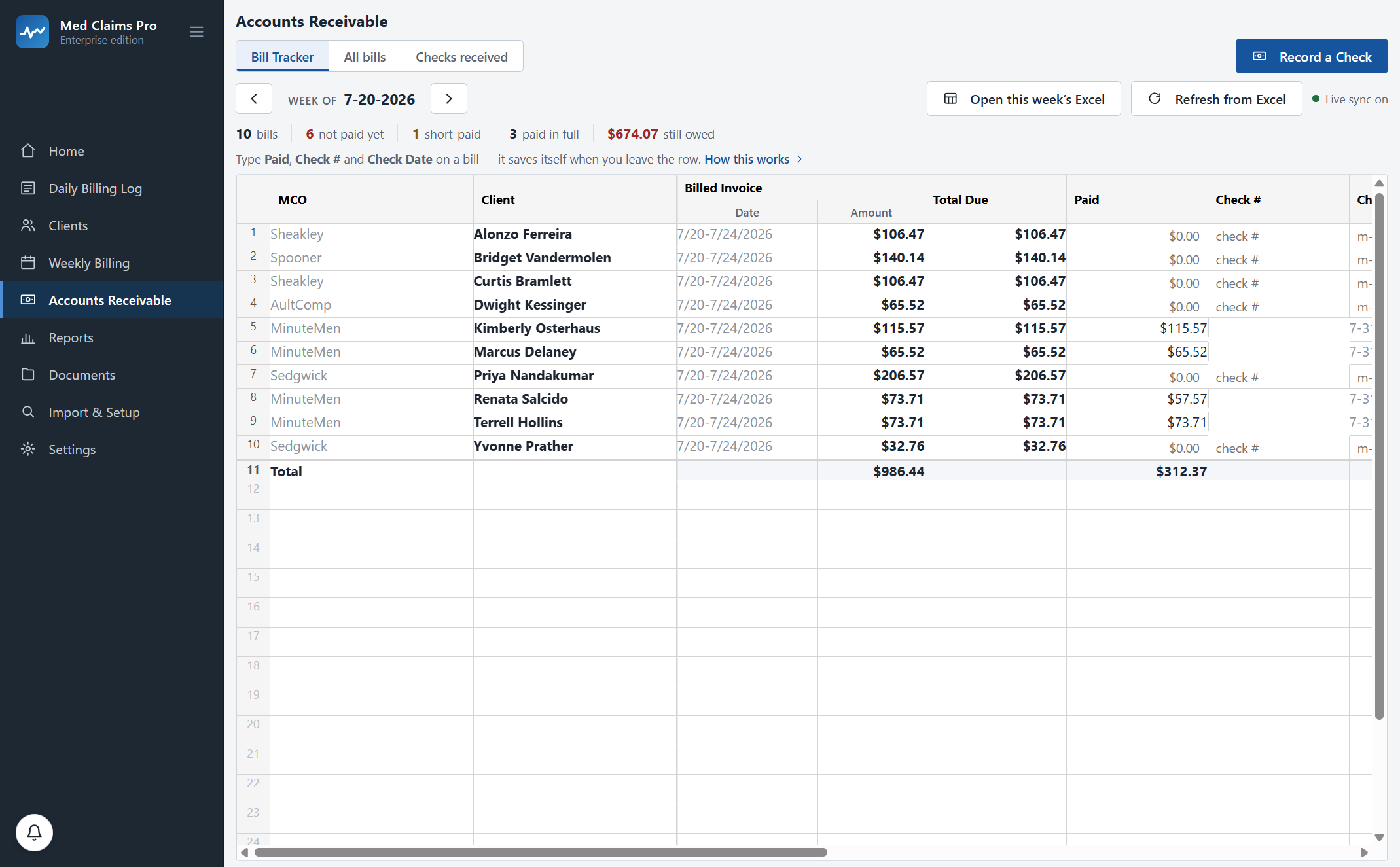
One check, many claimants. Whichever of these names is on the envelope, the check covers a dozen files at once. You record it once, tick the bills it pays, and anything short is flagged with the exact gap and the original form attached, ready to rebill. How that screen works.
Billing addresses and submission preferences go stale faster than any page can keep up, so we publish them only where we keep them current — today that is Ohio’s nine MCOs. Your Kentucky payers and their submission preferences get set up during onboarding, from your own files.
Case files, adjusters, mileage, receivables.
Nurse case management billing works in Kentucky today with no state-specific setup: activity grid, the priced lines your invoice is built from, mileage and wait time as their own lines, aging by payer.
The activity grid
Field visit, telephonic call, wait time at the appointment, the miles there and back — logged once, with the claim number, the adjuster and the referral source attached as you type.
The log behind the bill
A weekly narrative log per case file, dated and grouped, reproducing your own Word template — and where a payer wants a CMS-1500 the software fills one. It does not write an invoice document today: the dated, timed, priced lines that go on yours come off the grid.
Aging by payer
KEMI, the carriers and the TPAs, each with billed, paid and still-owed, and an aging list that names who is sitting on your money.
It is the same week an Ohio vocational rehabilitation case manager works, in different nouns: case files instead of claimants, adjusters instead of MCO coordinators, billable hours and mileage instead of W-codes. Thirty-odd billable touches a day either way, and the same four documents behind every one of them. The nurse case manager page has the whole workflow.
Where the rules actually live.
Ask the Kentucky Department of Workers' Claims for
- the rules that govern rehabilitation billing in Kentucky
We have not published a verified link set for Kentucky yet, and we would rather send you nowhere than somewhere out of date. If you have the current documents, send them over — admin@onservice.us.
How we keep this page honest
Every fact above is transcribed from the Kentucky Department of Workers' Claims or the statute named, dated July 2026, and reviewed when the agency republishes. Where we have not verified something we say so rather than filling the gap.
Found something out of date? Tell us and we will fix it the same week: (302) 202-3172 or admin@onservice.us.
See a Kentucky case-management caseload run itself.
Fifteen minutes, a case-management caseload on screen, and an honest answer about what Kentucky voc rehab would need. Or join the Kentucky voc-rehab list and we will write to you when there is something real to show.
There is a phone number and a person answers it: (302) 202-3172.
States that work like Kentucky
Questions, answered.
How do vocational referrals happen in Kentucky?
By order of an administrative law judge, which makes them rare and unpredictable. That is the honest description of the market.
What is dependable here?
Nurse case management, invoiced to KEMI, the carriers and the TPAs. It works today with no state-specific setup.
Do you support both kinds of file?
Yes — the same activity grid produces a case-management invoice and, when a judge does order vocational work, the documentation and billing for that too.
Is there a Kentucky rate we should know?
Not one we have verified, so none is printed here.
Where does my data live?
On your computer, in your own folders.
See your own week run itself.
We load your state’s codes before the call, so you are looking at a caseload like yours inside the first two minutes — not a slide deck.