A service takes a percentage of every check.
It does not write your tracking log.
Outsourcing the billing is the most reasonable idea on this list, and it is the one most voc-rehab practices price out at least once. Here is what it costs on a real book, what it genuinely takes off your desk, and the specific part of your week it cannot touch — because that part is documentation, not billing.
$13,600 a month. At 6%, that is $816 — every month, forever.
Our first customer’s Ohio voc-rehab practice bills about $13,600 a month. That is a real book, not an illustration. Run the standard percentages against it and the range is not subtle.
| Rate | Per month | Per year |
|---|---|---|
| 3% — daisyBill’s own service, starting | $408 | $4,896 |
| 5% — low end of typical | $680 | $8,160 |
| 6% — the common quote | $816 | $9,792 |
| 8% — high end of typical | $1,088 | $13,056 |
| Flat-fee firms | $500–$2,500 | $6,000–$30,000 |
Workers’-comp revenue-cycle pricing runs 4–10% of collections, with 5–8% typical; the cloud practice-management firms that bundle revenue-cycle billing quote 4–8%. Some smaller firms take a flat monthly retainer instead.
A percentage has one property worth naming out loud: it is indexed to your success. A good month costs more. A short-pay you chase down and recover costs you six percent of the recovery. Nothing about the service’s workload changed — only your revenue did.
Med Claims Pro is flat. $49 or $299 a month whatever you bill, and no percentage of anything you recover.
Service percentages are the published/typical 2026 ranges for workers’-comp billing and revenue-cycle firms; daisyBill’s billing service starts around 3%. Current as of July 2026 — verify with each service. The $13,600 book is our founding customer’s actual monthly billing.
A service starts work after the hardest part is already done.
Think about what you have to hand over before a biller can do anything at all. For each injured worker, for each week: the activities, the dates, the codes, the units in tenths of an hour, the level suffix, the claim number, the MCO, and the narrative that travels with the bill.
That is the work. Producing coded, timed, documented activity is the bulk of a voc-rehab billing week. Dropping it onto a CMS-1500 and faxing it is the last ten minutes.
So the honest description of a billing service is: you do the documentation, they do the submission and the chasing. That is a real service and for some practices it is worth every dollar. It is just not the thing that ends your Sunday evening.
And they will not write the log. A billing company does not open your Word template and write this week’s narrative for an injured worker they have never spoken to. In Ohio that tracking log travels behind the CMS-1500; without it the packet is incomplete. No percentage covers it, because it is not billing.
$816 a month buys the last ten minutes. $299 buys the whole week.
what a 6% service costs you over Professional in a single year on a $13,600 book — and the service still leaves every line of documentation on your desk.
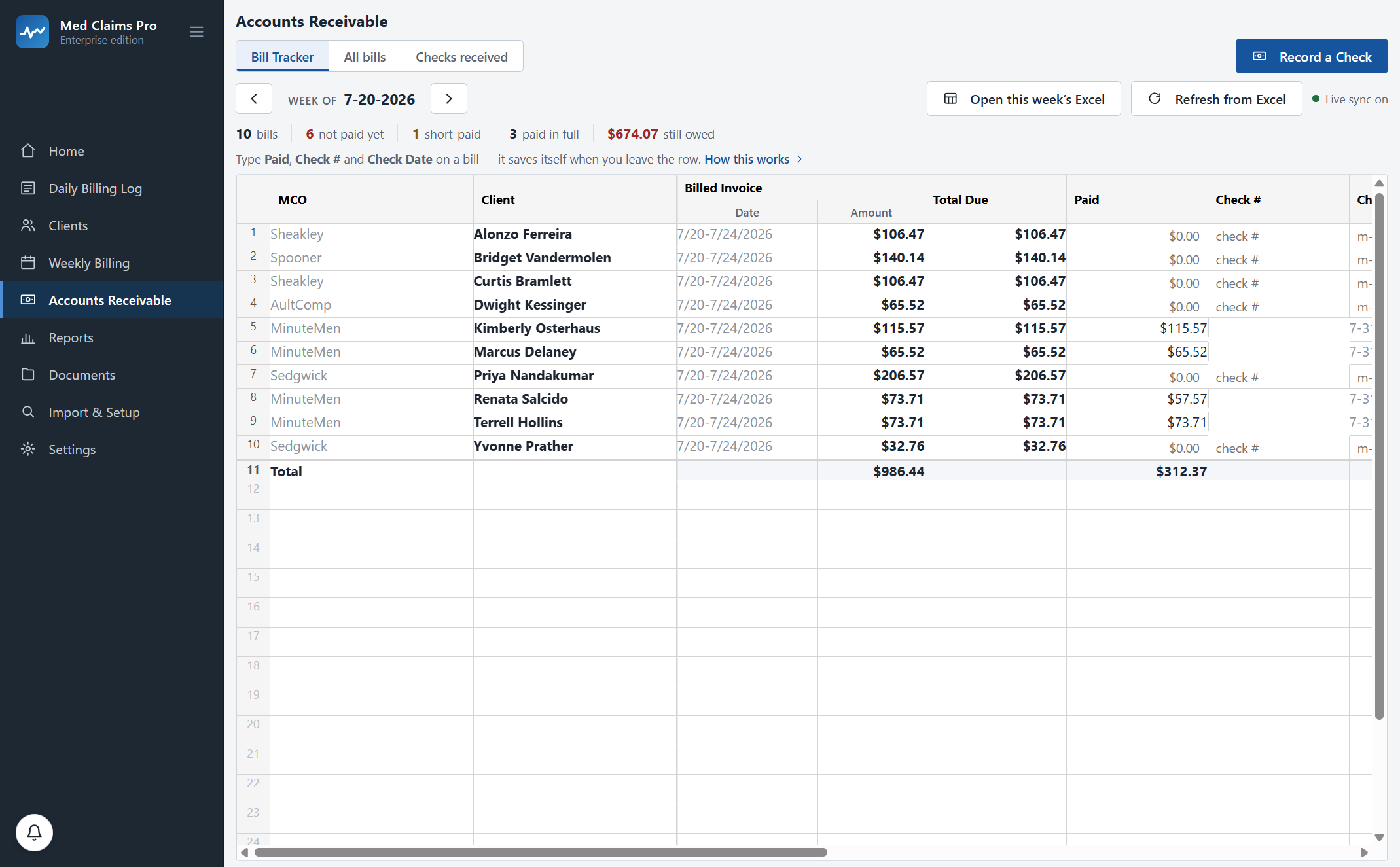
Set the two side by side on the same book. The service handles submission and collections and leaves your documentation exactly where it was. The software removes the retyping, writes the log and the claim form, tracks the receivable, and flags the $16.14 the MCO kept — and leaves the payer phone calls with you.
That is the real trade, stated plainly: a service takes the phone calls, software takes the typing. Only you know which one is eating your evenings. For a solo voc-rehab practice our own view is that it is the typing, by a distance — but it is your week, so test that against it.
And you can have both. You could keep the service for collections and run this for documentation, coding and your own receivables view — so you can check the service’s work instead of taking its word for it. If that is your situation, say so on the call.
Professional is $299/mo, or $239/mo billed annually — $720 a year less. Difference against a 6% service on this book: $6,924 a year. Additional Professional users are $199/mo. Full pricing →
Four situations where you should hire the biller, not buy the software.
If any of these describe you, a service is the better purchase and we would rather you found that out here than on a demo call.
You bill a lot, across many states and payers
Multi-state, multi-carrier, high volume, constant enrollment and credentialing work — that is a full job, and a firm that does it every day will beat a solo practitioner with any software. Your state is configured one at a time.
Your book is small
Billing $3,000 a month? A 6% service is $180 and is cheaper than we are. The percentage model is genuinely kind to small books, and we are not going to argue you out of arithmetic that favors you. Come back when the book grows.
Denials and appeals are your actual pain
If what is killing you is fighting bill review rather than producing paperwork, a service — or daisyBill, whose users report recovering $100 million-plus through its appeals tooling — addresses that head-on. We flag the gap and assemble the evidence; we do not file the dispute for you.
You will not adopt software, and you know it
Some people genuinely do not want a new screen in their week, at any price. That is a legitimate answer, and a service is how you buy your way out of it. Nothing here works if it does not get typed into.
“My biller already gives me an aging report.”
They do — theirs, on their schedule, built from what they submitted. What it cannot tell you is whether the $73.71 you billed for Doe, Jane R.’s week came back as $57.57, because the service is reconciling against what it sent, not against the tracking log and the activity grid behind it. Your own receivables view is not duplicated work; it is the only place the two halves meet.
“Is my claimant data safe with either of you?”
With us there is nothing to be safe from: every claim, note and document lives in a database on your computer. Our server holds your license and nothing else. A billing service, by definition, receives and stores your claimants’ data on its own systems — which is normal and lawful under a business associate agreement, and is still one more place your injured workers’ records exist. How local-first works →
“Do you take a percentage of what you recover for me?”
No. Flat monthly subscription. No percentage of collections, no per-claim fee, no success fee on a short-pay you get back. If the software flags $16.14 and you recover it, you keep $16.14. That is the whole structural difference between a subscription and a service.
“Switching sounds like a lot of upheaval.”
You are not switching a payer relationship or moving a book — you are changing where you type. Onboarding reads your existing workbooks and client folders without altering them, and configures your templates and your state’s codes in the first week. Keep the service running while you trial it if you want to.
“What if it does not save me the time you say?”
Sixty-day money-back guarantee: if it has not earned its place in your week, tell us and we refund every cent and export your data. You do not have to justify the answer. Free trial before that, no card. Cancel whenever — no contract, and the software goes read-only rather than dark.
Bring one real month of billing to the demo and we will run your own percentage against it on the call. Fifteen minutes. Or ask us on the phone: (302) 202-3172.
The other alternatives: Excel and Word by hand · daisyBill · CMS-1500 form-fillers · All four side by side
Questions, answered.
What does a workers' comp billing service actually cost?
Percentage-of-collections pricing runs 4–10%, with 5–8% typical; the cloud practice-management firms that bundle revenue-cycle management quote 4–8%, and daisyBill’s own billing service starts around 3%. Some smaller firms charge a flat $500–$2,500 a month instead. On a $13,600 month, 6% is $816. Current as of July 2026 — verify with each service.
Does a billing service write my weekly tracking log?
No. A billing company submits claims and chases payers; it does not open your Word template and write this week’s narrative for an injured worker it has never spoken to. In Ohio that tracking log travels behind the CMS-1500, so the documentation half of your week stays with you at any percentage.
Can I use Med Claims Pro alongside my billing service?
Yes, and for busy multi-state practices it is often the right answer. The software produces the coded activity, the documentation and the claim forms your service needs, and keeps your own receivables and short-pay view so you can check their work rather than take their word for it.
Is a percentage ever cheaper than a subscription?
Yes — on a very small book, against the full Professional plan. Billing $3,000 a month at 6% is $180, a little under $299. The crossover on a 6% rate sits just under $5,000 a month of billings, and above that the flat subscription pulls away fast because it does not rise when you have a good month. Against the $49 Forms plan a percentage service is never cheaper — but it is also not doing the same job.
Do you take a percentage of recovered short-pays?
No. Flat subscription, no success fee, no per-claim fee. What you recover is yours. How short-pay detection works →
My biller says they handle everything. What are they not handling?
Ask them three questions. Who writes the weekly narrative tracking log? Who assigns the W-code, the level suffix and the units in tenths of an hour? And when one MCO check covers sixteen claimants, who checks each line against what that specific form billed? The answers are usually you, you, and nobody.
See your own week run itself.
We load your state’s codes before the call, so you are looking at a caseload like yours inside the first two minutes — not a slide deck.