Six counselors. Six spreadsheets.
Let’s talk about what we can actually fix today.
Every counselor bills their own way, in their own workbook, on their own laptop, and month end is a merge job. We can take the paperwork off each of them right now. The single shared firm ledger is being built and we are not going to sell it to you as though it were finished.
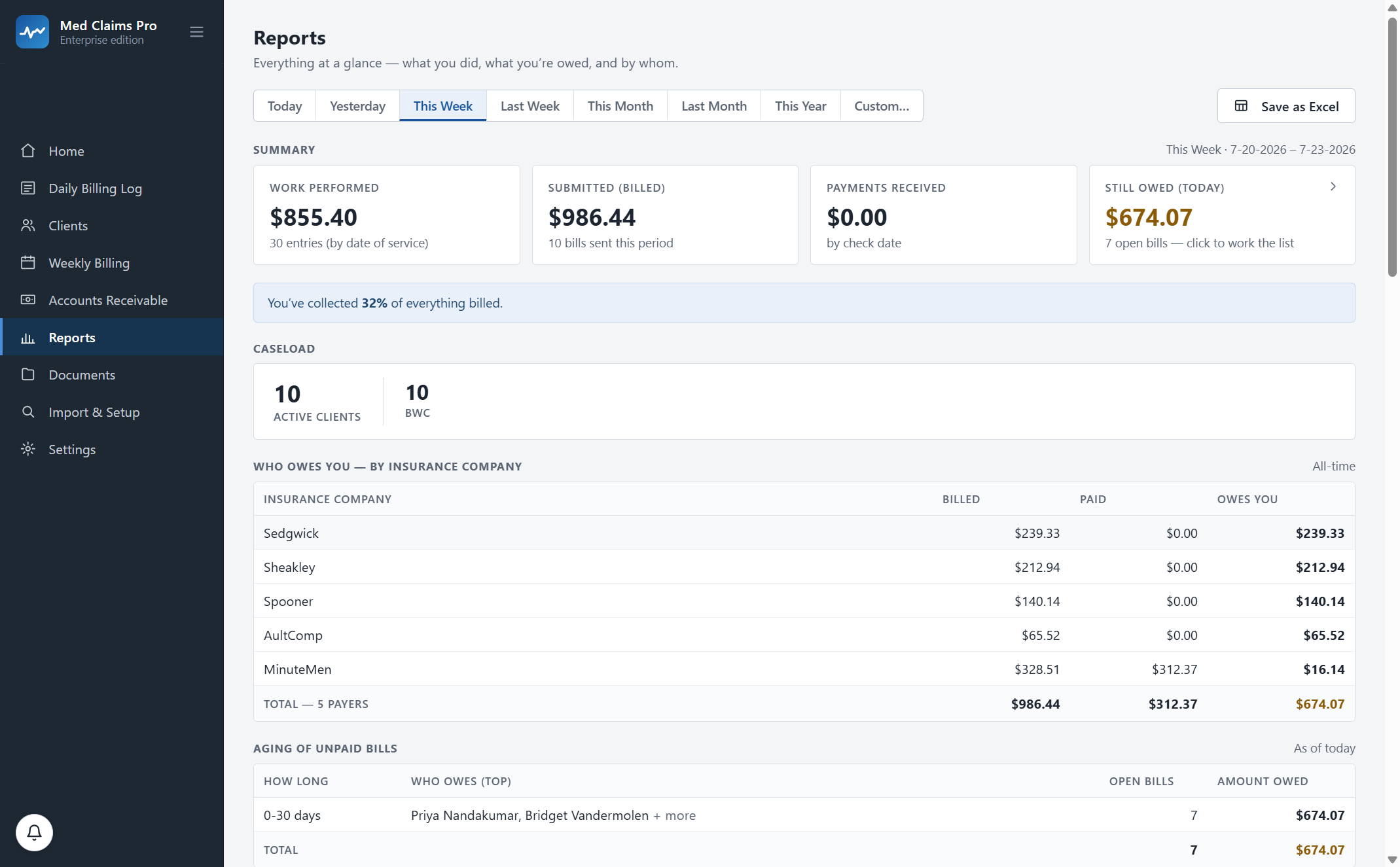
What a firm can buy today, and what it cannot.
What works today. Each specialist in your practice runs Med Claims Pro on their own Windows PC. Each one stops retyping the same activity into four documents; each one gets their daily log, their weekly Word tracking logs, their claim forms, their receivables and their fax confirmations. We set every person up in the same week, on your templates and your folder naming, and you get one invoice and one number to call.
For most firms of two to ten, that is where the hours actually go, and it is available now.
What does not work today. There is no shared caseload. Each specialist’s billing database lives on their own machine, so there is no single client list, no reassigning a case from one person to another inside the software, no roles and permissions, and no one screen showing the whole firm’s receivables. Month end is still a merge, though of far cleaner numbers than six hand-kept workbooks.
We are building it. It is a bigger job than the desktop app was, and anyone who tells you a firm rollout is a fortnight has not looked at the problem.
How a firm is priced
- Today
- A Professional plan for each specialist, quoted together. We price it on the call because it depends on how many of you there are and how many states you work.
- One invoice
- One bill for the practice, one setup week, one support contact.
- Historical import
- Done for you across every counselor’s folders rather than left as a self-serve wizard.
- When the firm platform lands
- Firms who came in early get it as it ships, at the price they are already paying.
- No published number
- We are not printing a firm price next to features that are not finished.
What we are building toward — and where each piece honestly stands.
These are the right problems; a firm owner will recognize all four. None of them is solved in the shipping software today. This is the order we intend to solve them in.
Shared caseloads NOT BUILT
One client list for the firm, files reassignable when someone goes on leave, activity history traveling with the case. This is the largest piece by a distance — it means moving case records off individual machines, which changes the privacy promise the product is built on. It is the last thing we will ship, not the first, and we would rather explain that than surprise you with it.
Users and permissions IN PROGRESS
Named users under one account, an owner who can add and remove people, and an office assistant who enters activities but cannot touch payments. Most of the groundwork for this exists on the licensing side; it is the nearest of the four.
Firm-wide receivables NOT BUILT
What the practice billed, what came back, what is short-paid, which payer is at sixty days — as one list rather than several. Doable as a roll-up of totals without moving any claim detail off anyone’s machine, which is how we intend to do it.
Work and output by person NOT BUILT
Billed hours, units and dollars per specialist, per week, per payer — the number you currently reconstruct from six workbooks when you are deciding whether to hire. Same approach: totals, not records.
Two to ten people who bill their time against claim numbers.
QRC firms
Minnesota’s Department of Labor and Industry registers over 200 Qualified Rehabilitation Consultants across roughly seventy firms. Hourly invoices, R-forms, rehabilitation plans — multiplied by every QRC on the letterhead. Minnesota billing →
Rehabilitation supplier groups
Georgia’s registered rehabilitation suppliers under Board Rule 200.1, and the catastrophic side, often practice in small groups with a shared administrator. Georgia billing →
Vocational rehab practices
Ohio VRCM practices with two or three counselors and one person who does the billing for all of them, across several MCOs. Ohio billing →
Nurse-case-management shops
Field and telephonic NCM firms of two to ten, invoicing carriers and TPAs. Supported in every state today — no state configuration required. Nurse case managers →
Your clients’ data still never touches our servers.
A firm database is a bigger liability than a solo one, so the architecture matters more, not less. Today the database and every generated document live on your own machines and in your own folders. Our server holds accounts and licenses — no claim numbers, no names, no notes, no documents. Cancel and it goes read-only: your records stay readable and exportable, which is the answer your own risk review will want.
When the firm view arrives, our intention is that it carries totals, never records — what was billed and collected, not who the claimant was. If we ever needed to change that, it would be a conversation with you first, not a release note.
Bring one real week from two counselors.
Fifteen minutes, your state’s codes and both caseloads on screen. We will show you what each person’s week looks like, tell you plainly what a firm does and does not get today, and give you a straight answer on timing for the rest. Or call and ask — a person answers: (302) 202-3172.
Questions, answered.
Can two of us work in the same caseload at the same time?
No — not today, and this is the honest answer we would rather give you now than in week two. Each specialist runs their own copy on their own Windows PC with their own billing database on that machine. There is no shared client list and no way to reassign a case inside the software. A genuinely shared caseload is being built; it is the largest thing on our list and we are not going to put a date on it here.
So what does a firm actually get today?
Each person gets the full Professional product — daily log, weekly Word tracking logs, claim forms, receivables, short-pay detection and faxing — set up on your templates and folder naming in the same week, with one invoice for the practice and one support contact. For most firms that is where the hours are going.
Can an office assistant enter activities without seeing the money?
Not yet. Roles and permissions are the nearest piece of the firm platform to being finished, but there is no login and no role system in the shipping software today, so anyone at a machine sees everything on that machine.
What does it cost for a firm?
We quote it on the call, because it depends on how many specialists you have and how many states you work. We are deliberately not publishing a firm price next to features that are not finished. Firms who start now get the firm platform as it ships, at the price they are already paying.
What if our counselors work in different states?
That works today for Ohio, which is the one jurisdiction pack that ships configured. For any other state we configure the codes, the rates, the form and the payers with that person during the setup week — so ask on the call where your states actually stand rather than assuming parity. Two limits worth hearing now: the software generates the CMS-1500 and not any state-specific form or invoice document, and you do not get both people in one shared ledger.
How does the historical import actually work?
We do it for you across each counselor’s folders: we read the existing client folders, weekly tracking logs and billing workbooks and bring the history in, keeping your folder structure and naming intact. It is a read of your files, not a rewrite of them — nothing is moved or renamed without your say-so.
What happens to the firm’s records if we cancel?
The software goes read-only for everyone. Every user keeps viewing and exporting their case files, documents and receivables, in your formats, indefinitely. No deletion, no export fee, and no contract to be released from.
See your own week run itself.
We load your state’s codes before the call, so you are looking at a caseload like yours inside the first two minutes — not a slide deck.