The check came. Sixteen claimants.
Three of them short.
A payer that pays $57.57 against a $73.71 bill is not disputing anything. It is a unit-math error, or last October’s fee schedule, or a B form paid as if it were the A form. You would find it eventually — at 11 p.m., with the remittance in one hand and the Bill Tracker in the other. Med Claims Pro finds it while the check is still in your hand.
Nobody reconciles nine lines at 11 p.m. Not really.
You mean to. You get four lines in, the totals nearly match, the rest of the week is waiting, and the bill goes in the “I’ll chase it later” pile. Later is March. By March the amount is small enough to feel not worth the phone call, and the filing window has been quietly eating it the whole time.
Multiply that by a year. Short-pays are not one big theft, they are forty small ones — which is exactly why they survive. Each individual gap is too small to interrupt your day for, and the sum of them is not.
The comparison is the whole feature. Every amount you apply is measured against what that form actually billed. Not the client total. Not the week total. The form, which is what the payer paid against.
Why bills come back short
- Unit math
- Box 24G. You billed 0.1 units as “1”; bill review priced it as one hour, or as nothing.
- A stale fee schedule
- Ohio’s voc-rehab rates change every October. A payer still running last year’s table underpays every line by the difference.
- Overflow forms
- Your week ran past six lines onto a B form. The payer paid the A form and treated the B as a duplicate.
- Dropped lines
- A line disappears in bill review and the remainder still looks roughly right on the check.
- Rounding
- Cent-level differences on unit-priced codes that nobody notices until they are a year of cents.
$73.71 billed. $57.57 paid. Flagged before you closed the screen.
One MinuteMen check covered sixteen claimants this week. Thirteen came back in full. Three did not, and they said so before the screen was closed. Invented names, real MCOs, real code rates.
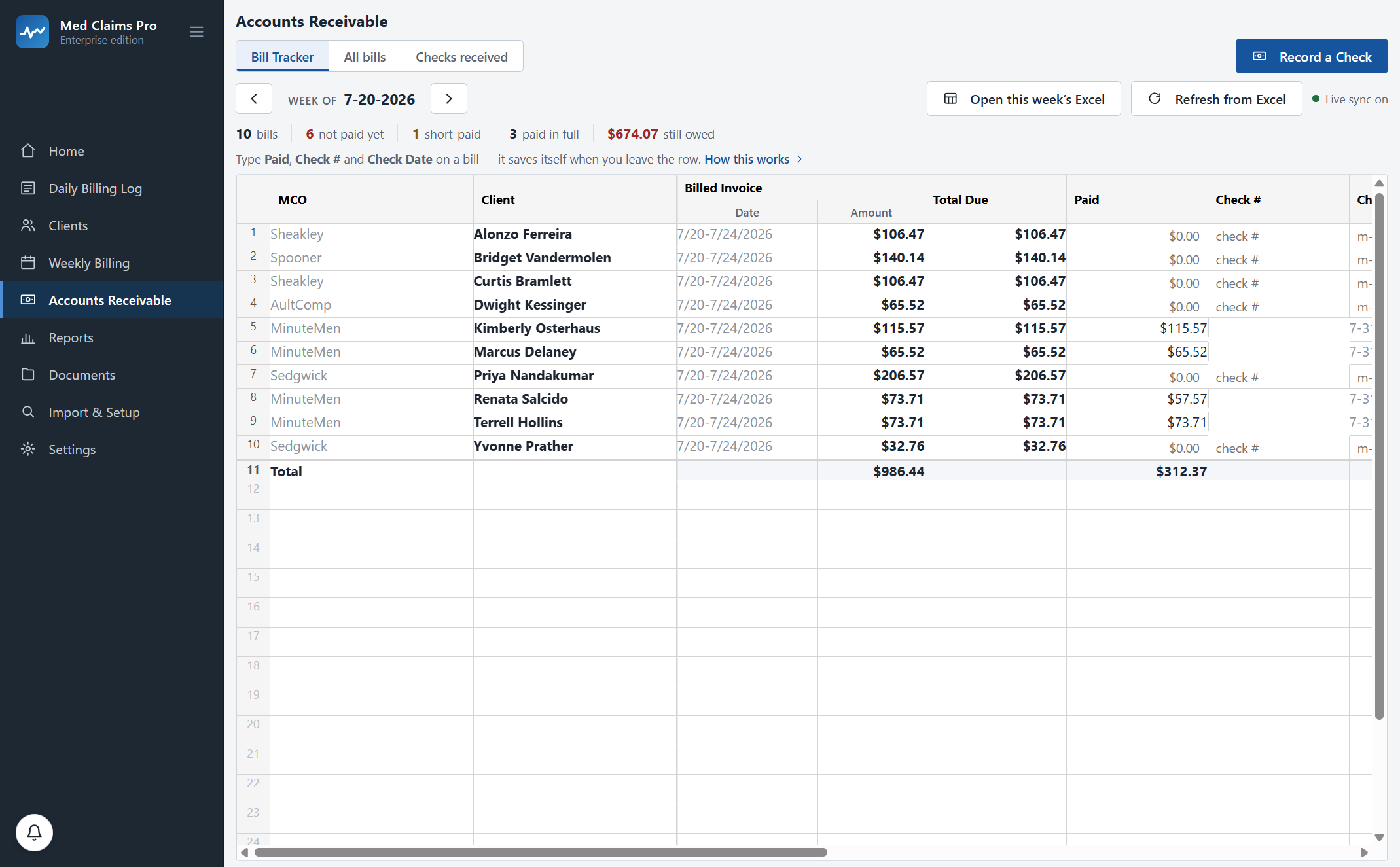
Detection is automatic. The evidence is already filed.
The gap surfaces itself
The instant the check is recorded, the bill flips to Short paid with the missing amount in dollars and cents. It is not a report you have to run and it is not a color on a row you might scroll past — it is a status, and it counts in the week’s header.
The packet assembles itself
The original CMS-1500 — locked since the day you marked it billed — the weekly tracking log that matches it line for line, the claim number, the check number and date, and the computed balance. All of it already attached to the bill, in that claimant’s folder, because it was filed there when you sent it.
The clock is visible
Days waiting counts on every open balance, and aging buckets keep a short-pay from sliding past your state’s filing window while nobody is looking. In Ohio the window is a year from the date of service — long enough to lose a bill in, which is how bills get lost.
Ohio timely filing: one year, per Ohio BWC. Current as of July 2026 — verify with Ohio BWC. Other states run shorter clocks; see timely filing by state.
The category leader built its reputation on exactly this — for a different profession.
daisyBill is the closest thing workers’-comp billing has to a category leader. Its signature feature is second-review and appeal automation, and the company reports that its users have recovered more than $100 million in underpayments through it. That number is not our number and we do not claim it. We point at it because it settles an argument: underpayment in workers’ comp is a real, measurable, recoverable wound, and software that catches it pays for itself.
Now the part that matters to you. daisyBill is built for California physician practices, surgery centers and third-party billers, and starts at $300 a month. It does not know Ohio BWC voc-rehab W-codes. It has no activity grid, no weekly narrative tracking log, and no concept of a counselor’s caseload. It is a good product aimed somewhere else.
Nobody has built the same thing for your side of workers’ comp. That is the gap this page is about.
2% is an illustration, not a measurement — nobody can tell you your rate but your own remittances. Measure it with the free short-pay calculator, then decide.
What we do, and what we will not promise.
What it does
Compares every applied amount to what the form billed. Flags the gap to the cent. Preserves the original claim form and the log behind it as evidence. Keeps the short-pay in a queue with its balance and its age until you close it. Lets a later check post against the same bill without losing the first one.
What it does not do
It does not guarantee recovery — no software can, and anyone who tells you otherwise is selling. It does not file your state’s dispute for you; automated state-specific reclaim packets are on the roadmap, and we will say so until they ship. And it never takes a percentage of what you get back. Flat subscription. What you recover is yours.
And it runs on your rate agreements, not ours. During onboarding we configure Med Claims Pro to your exact formats, your folders, your payers and your state’s codes — so from day one the comparison measures each check against what you actually billed. Included in every plan, not an add-on.
Bring one real remittance to the demo and watch it get taken apart. Fifteen minutes. Or call and ask: (302) 202-3172.
Questions, answered.
How does the software know a bill was short-paid?
Because it knows exactly what the form billed. When you record a check and apply an amount to a bill, that amount is compared to the billed total for that form — not the client, not the week. If it is less, the bill becomes Short paid and the difference is stated in dollars and cents. There is nothing to run and nothing to remember.
What if the payer short-paid for a legitimate reason?
Then you close it. A flagged gap is a question, not an accusation — some are genuine adjustments and some are errors, and only you can tell them apart. What the software guarantees is that you get asked the question while the check is in front of you, instead of finding out in March.
Can it find short-pays from before we started using it?
Yes, within reason. The historical importer reads your existing billing files without altering them, and the same comparison then applies to any bill with a recorded payment. Watch the filing clock — old gaps may already be past your state’s window, and no software can reopen that.
Do you take a percentage of what we recover?
No. Flat monthly subscription, no percentage of collections, no per-claim fee, no success fee. What you recover is yours. That is the whole difference between this and a billing service.
Does it read the EOB or remittance automatically?
Not today. You record the check and the allocations; the comparison against what you billed is what the software does. Automatic remittance reading is on the roadmap, and we will tell you when it ships rather than before.
Is short-pay detection in every plan?
It is in Professional ($299/mo, $239 billed annually), alongside receivables and one-check allocation. Forms at $49/mo covers clients, the daily billing log and the claim forms, without the receivables block. Free trial, no card; Sixty-day money-back guarantee. Full pricing →
See your own week run itself.
We load your state’s codes before the call, so you are looking at a caseload like yours inside the first two minutes — not a slide deck.