The CMS-1500 is the last ten minutes
of a nine-hour week.
A form-filler prints a clean claim form for very little money, and it does that job properly. What it cannot know is that the form is the end of the work — the units, the level suffix, the narrative log behind it, the overflow onto a B form, and whether anyone ever paid it. Here are the three you have probably priced, and where each one stops.
We cost about six times a $79 form-filler. That is a fair thing to hold against us.
medclaimsoftware.com is $79 a year for the paper version. Our entry plan is $468 a year. You can do that division, and you should. If the claim form is genuinely the whole problem — if you bill four CMS-1500s a month and your documentation is already handled — then buy the $79 one and close this page with our blessing. It is the right purchase.
What the extra buys is not a nicer form. It is the client and case structure, and the daily billing log that produces the lines the form is made of — your codes, your rates, your tenths of an hour, written into your own Excel file as you work. No form-filler has any of that, at any price.
The rest of this page is for the counselor billing thirty injured workers a week, in tenth-of-an-hour units, with a Word tracking log behind every claim form and an MCO sitting on $674.07. For her the form-filler is not the wrong product. It is the right product aimed at ten minutes of a nine-hour problem.
The form is not the work. Producing coded, timed, documented activity is the work. The form is where it gets written down last.
Vendor pricing current as of July 2026 — verify with each vendor. Forms is $49/mo, or $468 for the year; Professional is $299/mo, or $2,868 for the year.
What each one is, and what it is honestly good at.
| Product | What it is | Price | Where it stops for voc rehab |
|---|---|---|---|
| medclaimsoftware.com | Windows CMS-1500 and UB-04 form-filler. Prints alignment-perfect claim forms, keeps a list of what you printed. | $79/yr paper $289.95–$389.95/yr electronic (837P) |
No fee schedules, no receivables, no documentation. You are the fee schedule and the reconciliation. |
| Speedy Claims / SpeedySoft | CMS-1500 suite with a basic ledger. A step up: it remembers payers and keeps simple balances. | $41.95/mo or $384.95/yr desktop $69.95/mo or $659.95/yr cloud |
The ledger is a general one. It has no W-codes, no unit math, no tracking log, and no idea that one MCO check covers sixteen claimants. |
| EZClaim | Small-practice billing and practice management. A real product with scheduling and claim workflow behind it. | $199/mo first user +$149/mo each additional |
Generic small-practice billing, not workers’-comp-native. No voc-rehab code families, no narrative reporting, no case-management day. |
Swipe the table sideways for the rest of the columns →
Vendor pricing and descriptions as published by each vendor; current as of July 2026 — verify with each vendor. All three are other companies’ products and we have no relationship with any of them.
A form-filler has no concept of your day.
This is not a flaw. It is the category. A form-filler is a very good typewriter for one specific piece of paper. Here is everything that piece of paper is downstream of.
No concept of your day
Thirty to forty activities, in tenths of an hour, five days a week. W3220 for the notes you reviewed at 7:13 a.m. W3207 for the emails about authorization #4. W3235 for the progress report. A form-filler opens with a blank CMS-1500 and asks you what to type in Box 24 — which means the activity log, the coding and the unit math all happened somewhere else first, by hand.
No fee schedules
It does not know that a plan-implementation W-code bills at $81.90 a unit at Level 1 and $84.40 at Level 2, or that an assessment code is $91.00, or that Ohio changes those rates every October. You type the dollar figure. If you type $81.19, nothing on the screen disagrees with you, and the payer will not tell you either.
No receivables
The moment the form prints, most form-fillers stop thinking about it. Nothing tracks that the bill went to MinuteMen on the 20th, that $57.57 arrived against $73.71, that $16.14 is missing, or that a different payer has been sitting on your money for sixty-one days. That tracking has to live somewhere — so it lives in a spreadsheet you maintain.
No documentation
In voc rehab the report travels with the bill. The weekly Client Tracking Log, in your Word template, matching the claim form line for line, filed in the client’s folder. A form-filler will never write a sentence of narrative, because the profession it was built for does not send one.
Six lines to a page. Your week ran to nine.
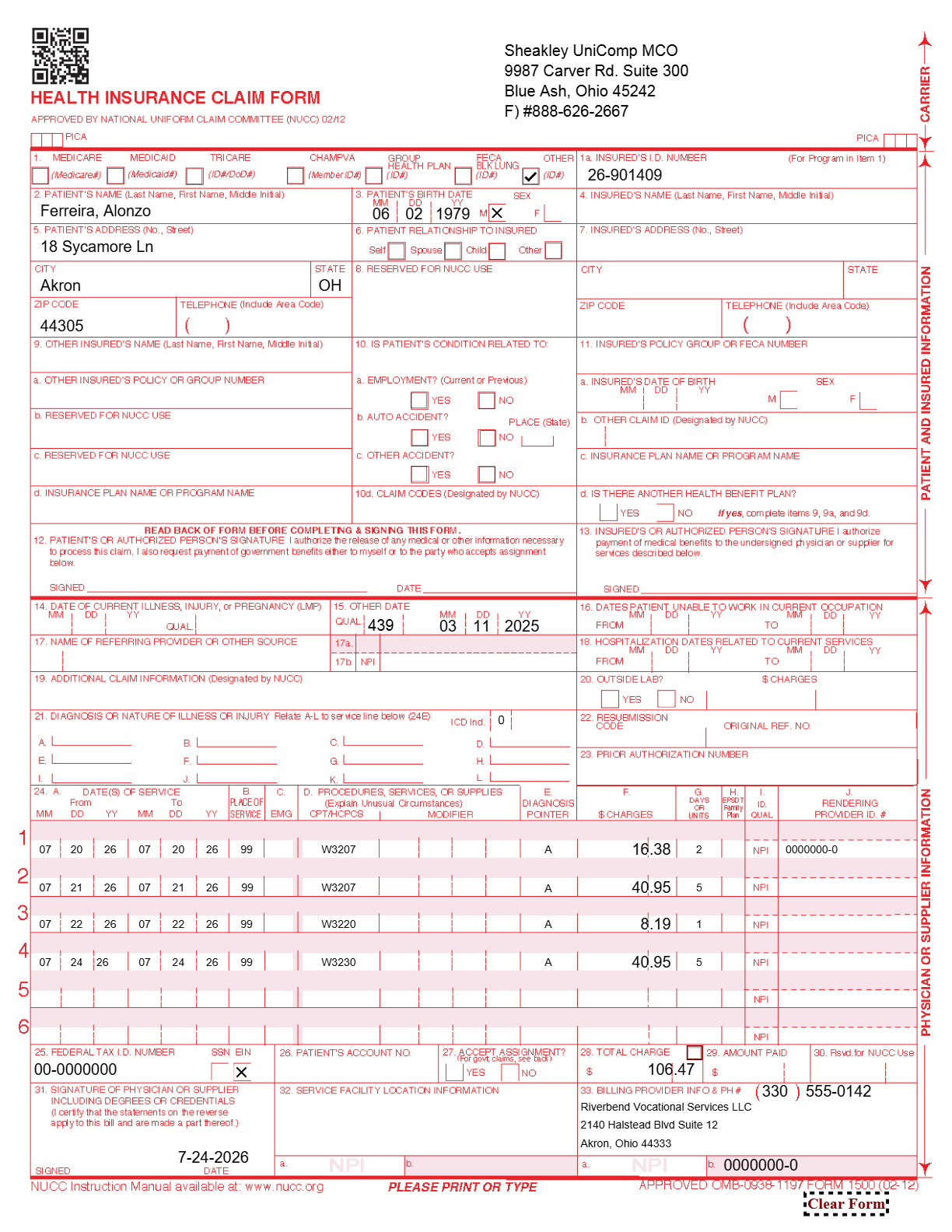
Here is the moment every voc-rehab counselor with a form-filler knows. The CMS-1500 holds six service lines. A normal week for one injured worker is nine, eleven, fourteen. So you start a B form: same claim number, same payer header, the remaining lines, the right page marking so bill review does not treat it as a duplicate and pay one of them.
A form-filler will happily let you do that, and will not check any of it. It also will not notice that the B form uses last October’s rate, that Box 15 wants the date of injury and Box 14 should be blank, or that this claimant’s MCO changed from ProMedica to Sheakley halfway through the case.
So the form-filler makes you four things: the fee schedule, the overflow logic, the file clerk, and the receivables ledger. You were already all four. The $79 simply does not change that.
What happens here instead
- Units
- 0.1 hours becomes the figure the form wants, priced at the code’s current rate for that level.
- Overflow
- Line seven starts a B form automatically, with the same claim number and the right payer header. C form after that.
- Rates
- Ship as data updates. New work uses new rates; historical activities keep theirs, the way an audit expects.
- Filing
- The PDF names itself and lands in the client’s CMS 1500 folder, the way you already name things.
- After it is sent
- The form becomes a tracked bill: billed date, payer, balance, days waiting, short-pay flag.
When a $79 form-filler is the right answer.
You bill a handful of forms a month
Four or five CMS-1500s, one or two payers, and your documentation is already handled some other way. There is no case for a monthly subscription here and we are not going to invent one.
Someone else does your documentation
If a partner, an assistant or a service already produces the coded activity and the narrative reports, then the form really is all that is left, and a form-filler covers it for the price of a lunch.
You are testing whether you even want this work
New to voc rehab, two clients, unsure whether the caseload grows. Spend $79. Come back when the Sunday evening starts.
“Is my claimant data going somewhere?”
No. Every claim, note and document lives in a database on your own computer, backed up on every launch and exportable any day. Our server holds your license and nothing else — which is the same answer a desktop form-filler gives you, and one of the reasons people like those products. We did not want to lose it.
“My form-filler works fine. Why change?”
Then the question is not the form-filler — it is what surrounds it. If you type the same week into a daily log, a Word tracking log, the form-filler and a Bill Tracker, the form-filler is one of four typings, and the other three are the expensive ones. That comparison →
“Do you print alignment-perfect red-drop forms?”
No, and this is the one place a form-filler still beats us. What the software prints is a complete CMS-1500 on plain paper — the whole form including the red-ink layout, filled — which is what Ohio MCOs accept by fax and what most payers accept on paper. Printing data-only onto preprinted red drop-out stock is not supported; do that and you double-print the form. If a payer of yours insists on the official red form, say so on the call. What does work: when a payer is not one of the packaged templates the form still generates, borrowing the blank and stamping that payer’s carrier block, and overflow to B and C forms is automatic at line seven with the claim number carried across. How the CMS-1500 works →
“My templates and folders are my own.”
Good — they stay that way. During onboarding we configure Med Claims Pro to your exact formats, your folders, your payers and your state’s codes, reading your existing workbooks and client folders without altering them. You do not reformat your practice to fit the software.
“I already paid for this year.”
Fair. Run the free trial anyway — no card — and keep the form-filler while you do it. Nothing here overwrites your existing files, and if it does not earn the difference you have lost nothing but an afternoon.
“What if it does not save the time you claim?”
Sixty-day money-back guarantee: if it has not earned its place in your week, tell us and we refund every cent and export your data. You do not have to justify the answer. No contract. Cancel and the software goes read-only rather than dark — your records stay yours.
Bring one real week to the demo and watch the forms build themselves, B form and all. Fifteen minutes, your state’s codes on screen. Or call: (302) 202-3172.
The other alternatives: Excel and Word by hand · a 5–8% billing service · daisyBill · All four side by side
Questions, answered.
What does CMS-1500 software cost?
medclaimsoftware.com is $79 a year for the paper version and $289.95–$389.95 a year for the electronic 837P version. Speedy Claims is $41.95 a month or $384.95 a year on the desktop, $69.95 a month or $659.95 a year in the cloud. EZClaim is $199 a month for the first user plus $149 a month for each additional. Current as of July 2026 — verify with each vendor.
Do any of them know Ohio BWC W-codes?
No. They are general CMS-1500 tools built around procedure codes and general fee schedules. Ohio’s voc-rehab code family — W3207, W3220, W3235, W3020, level suffixes, tenth-of-an-hour units, the October rate change — is a state-specific schedule for a profession none of them targets. You supply the codes and the dollar amounts by hand.
Will a form-filler handle a week that runs past six lines?
It will let you make a second form. It will not do it for you, will not carry the claim number and payer header across, and will not mark the pages so bill review treats them as one bill instead of a duplicate. Overflow to B and C forms at line seven is automatic here, because a nine-line week is normal in voc rehab and not an edge case.
Is EZClaim not basically the same price as you?
Close — $199 a month for the first user, and $149 for each one after, against $49 or $299 flat here, with the firm plan quoted on the call. The difference is not price, it is fit: EZClaim is generic small-practice billing and practice management. It has no voc-rehab code families, no time grid, no narrative tracking logs and no workers'-comp-native receivables.
Can I keep my form-filler and use Med Claims Pro for the rest?
You could, but you would be typing the claim form twice. The forms generate here from the same activity grid that writes your daily log and your Word tracking log, so the form-filler becomes the one step you did not need to keep. Most people drop it at renewal rather than on day one.
Do you do electronic 837P submission like the paid tier of a form-filler?
Not today. Fax with a filed confirmation, a portal upload you do yourself, and paper — which is the standard channel for Ohio voc-rehab MCO billing, and the confirmation filed in the client folder is your timely-filing proof. Direct e-billing for mandate states is on the roadmap and we will say so until it ships.
See your own week run itself.
We load your state’s codes before the call, so you are looking at a caseload like yours inside the first two minutes — not a slide deck.