Every state runs workers’ comp its own way.
Here is how yours pays you.
If you bill a workers’-comp payer for your time — VRC, VRCM, QRC, rehabilitation supplier, court-certified counselor, nurse case manager — one of these six is your state. Enrollment, authorization, the code set or the hourly rate, the form, the channel, the clock, and the short-pay — written from the agencies’ own rules, dated, and honest about what our research does not establish.
The states where a private voc-rehab practice actually bills.
Most states either never had a mandatory vocational-rehabilitation benefit or repealed it. These six have registered or certified private markets, published rules, and a real population of people doing this work. Each guide is written to be the answer — not an introduction to the answer.
Ohio
VRCM · Ohio Bureau of Workers' Compensation (BWC)
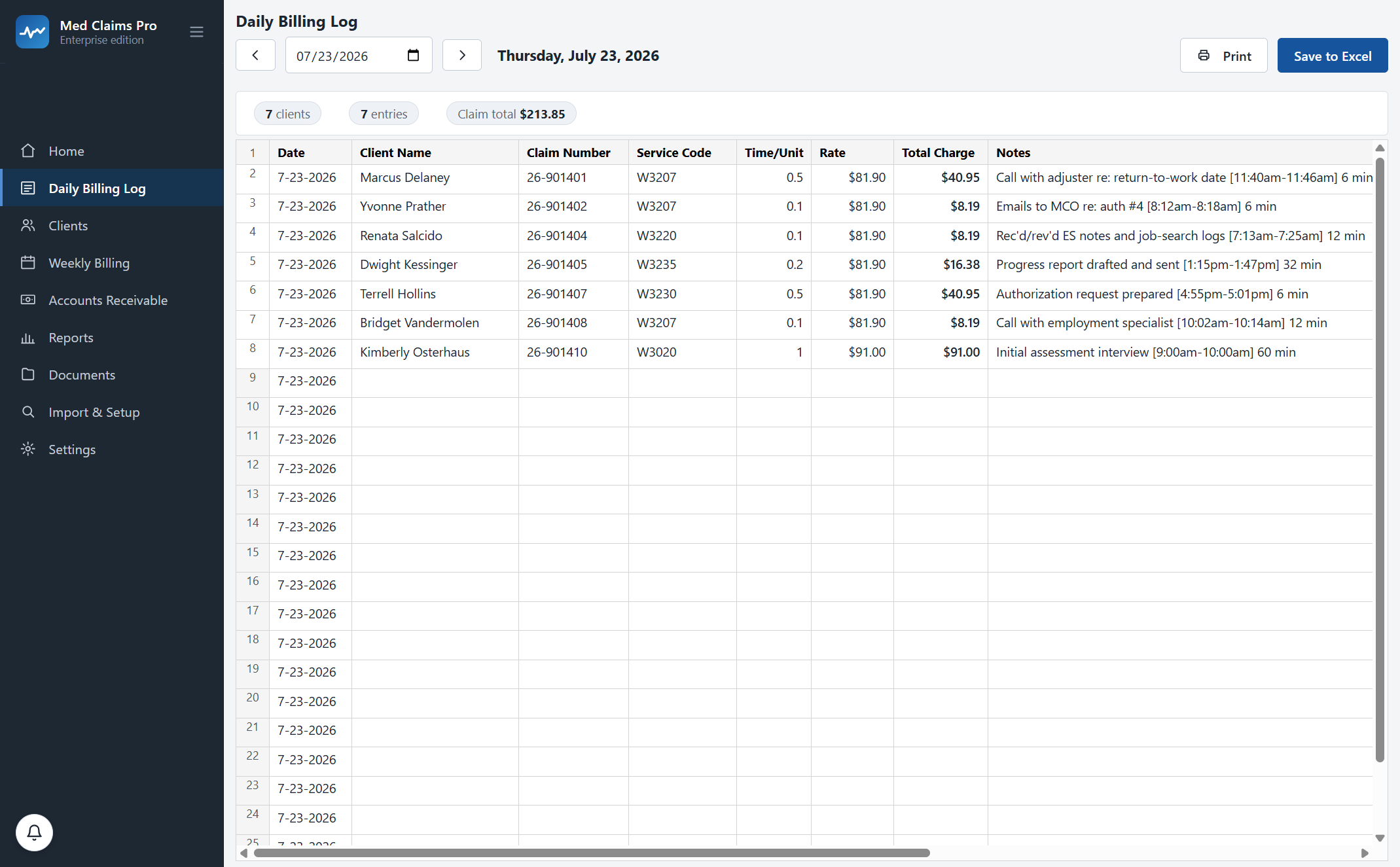
The whole Ohio voc-rehab billing chain: which MCO pays you, what the authorization has to say, what W3207 and W3235 are worth, and where the tracking log goes.
Washington
VRC · Washington State Department of Labor & Industries (L&I)
Billing L&I as a vocational provider: WAC 296-19A registration, MARFS Chapter 25 codes, 0810V at $11.05 a unit, and the per-referral caps you track yourself.
Minnesota
QRC · Minnesota Department of Labor and Industry (DLI)
QRC billing in Minnesota: DLI registration under Minn. Stat. 176.102, $129.98 an hour, $104.09 for placement, itemized invoices, and a 30-day payment clock.
Georgia
rehabilitation supplier · Georgia State Board of Workers' Compensation (SBWC)
Georgia SBWC rehabilitation supplier billing: registration under Board Rules 200.1 and 200.2, $124 catastrophic and $106 an hour otherwise, and 30 days to pay.
North Carolina
rehabilitation professional · North Carolina Industrial Commission (NCIC)
The NCIC registry under 11 NCAC 23C, how Form 25N assigns you to a claim, why North Carolina has no rehabilitation fee schedule, and what belongs on the invoice.
Nebraska
VR counselor · Nebraska Workers' Compensation Court (NWCC)
Court-certified voc rehab in Nebraska: NWCC Rule 40 certification, evaluation billed to the carrier, implementation billed to the state Trust Fund, and the VR-44S.
The same week, billed six different ways.
A counselor does roughly the same work in all of these states: thirty to forty coded, timed activities a day, across a caseload of fifteen to forty injured workers, about thirty of whom get billed in any given week. What changes is everything about how that turns into money.
| State | You bill | Form & channel | Rate basis |
|---|---|---|---|
| Ohio | the claim’s MCO | CMS-1500, W-codes, by fax | $81.90–$91.00/hr, in tenths |
| Washington | L&I or a self-insured employer | MARFS Ch. 25 codes, through My L&I | $11.05 per 6-min unit |
| Minnesota | the carrier | Itemized hourly invoice — e-bill mandate; R-forms via Work Comp Campus | $129.98/hr |
| Georgia | carrier, TPA or self-insured employer | Itemized time bill, direct to the adjuster | $106–$124/hr |
| North Carolina | the assigning carrier | Invoice after a Form 25N — e-bill mandate | market — no schedule |
| Nebraska | employer/carrier, then the Trust Fund | Court form VR-44S, direct | market — no schedule |
Current as of July 2026 — verify with the agency named in each guide. Every figure in this table is explained, sourced and dated inside its own guide.
There are fifty-one pages, and yours is one of them.
The guides cover the six states with the largest private vocational markets. The state pages cover all fifty states and the District of Columbia — who you bill, on what form, through what channel, on what fee basis, and under what clock, with the agency named.
If your state repealed its vocational-rehabilitation benefit, or delivers it through a state agency, the page will say so plainly rather than pretend there is a market. And in every one of those states, invoice-based nurse case management billing works today.
Because nobody had.
Search “how to bill BWC vocational rehabilitation” and you get a fee schedule PDF, a rule, and a forum post from 2014. The market is a few thousand people spread across fifty different statutes, so nobody built the software and nobody wrote the guide. That is not a discipline problem on your end. It is a market-size problem on ours, and we decided to write the guides anyway.
Every rate and rule number here is dated and attributed to the agency that publishes it. If you find one that is wrong, call (302) 202-3172 and we will fix the page — that is a better outcome for us than being quietly wrong in front of a few hundred colleagues who all know each other.
Questions, answered.
Are these guides free?
Yes, and ungated. No email box, no download form, nothing to sign up for. They are also not summaries of a paid thing — the rates, rules and form numbers are all here.
How current are the rates?
Every figure carries July 2026 as its verification month and names the agency to check it against. Fee schedules move on their own cadences — Ohio BWC updates in October, Washington L&I in July, Minnesota indexes annually — so verify before you bill from a number on any website, including ours.
Why only six states?
These are the six with registered or certified private vocational markets big enough that the how-to question gets asked. The other forty-five jurisdictions have fact pages under /states/ with the same discipline: what is true, what is not verified, and who to ask.
Do I need your software to use these?
No. They are written to be usable with a spreadsheet and a fax machine, which is how most of this work is done today. If you get to the end of one and think “this is four documents of retyping”, that is the part we sell.
See your own week run itself.
We load your state’s codes before the call, so you are looking at a caseload like yours inside the first two minutes — not a slide deck.