Type each activity once. Every document makes itself.
The daily Excel log, the weekly Word tracking log, the claim form, the receivables sheet — today you type the same six minutes into all four. Med Claims Pro writes all four from one entry, in your own templates.
You have been typing the same activity four times.
7:13 a.m. — you reviewed the job-search logs. Six minutes, one code. Tonight that entry goes into your daily log. Sunday it goes into the weekly tracking log. Then onto the claim form, line by line, six lines to a page. Then into the spreadsheet that tracks whether anyone paid it. Four copies of the same six minutes.
Rec’d/rev’d ES notes and job-search logs [7:13am–7:19am] 6 min
In Med Claims Pro you type it once, as it happens. Everything downstream builds itself.
A working caseload, inside the software.
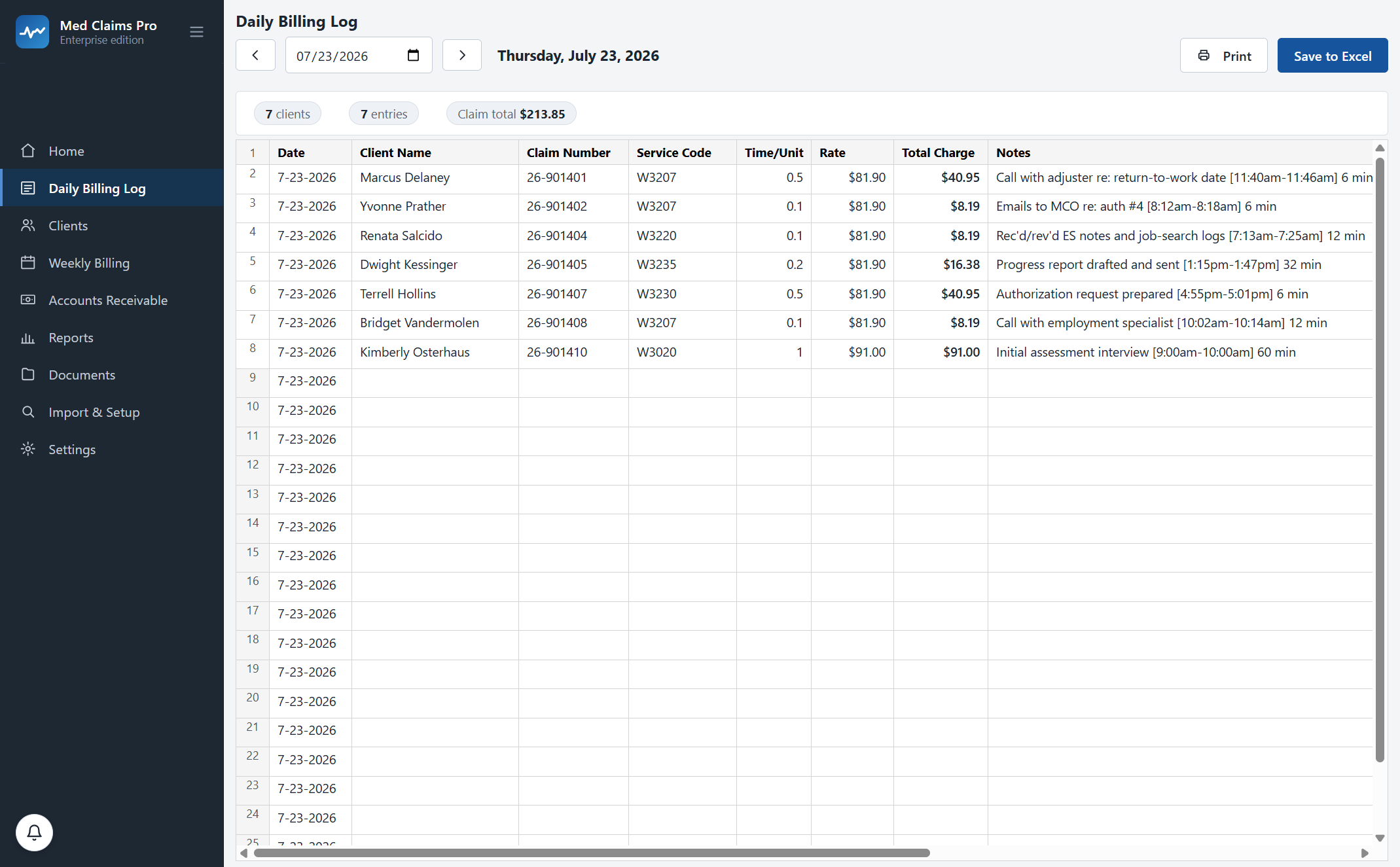
Names invented, workflow real — one Ohio week: 28 clients, $2,987.33 billed, off a Thursday of 31 entries across 22 claimants. Click through a day, a client list, a billing week, the check that came back, the short-pay it left behind, and the report that adds it all up.
Daily Billing Log — Thursday, July 23, 2026 · 31 entries · 22 claimants · $1,211.18
| Client | Code | Units | Rate | Charge | Notes | |
|---|---|---|---|---|---|---|
| Doe, Jane R. | W3220 | 0.1 | $81.90 | $8.19 | Rec’d/rev’d ES notes and job-search logs [7:13am–7:19am] 6 min | Saved ✓ |
| Doe, Jane R. | W3230 | 0.2 | $81.90 | $16.38 | Authorization request prepared [4:55pm–5:07pm] 12 min | Saved ✓ |
| Doe, John A. | W3207 | 1 | $81.90 | $81.90 | Plan development meeting with injured worker [9:00am–10:00am] 60 min | Saved ✓ |
| Doe, John A. | W3207 | 0.2 | $81.90 | $16.38 | Call with adjuster re: return-to-work date [11:40am–11:52am] 12 min | Saved ✓ |
| Doe, Jane M. | W3207W2 | 1 | $84.40 | $84.40 | Employer contact and job analysis write-up [10:10am–11:10am] 60 min | Saved ✓ |
| Roe, Richard T. | W3235 | 0.5 | $81.90 | $40.95 | Vocational assessment write-up [2:00pm–2:30pm] 30 min | Saved ✓ |
| Roe, Mary K. | W3020 | 1 | $91.00 | $91.00 | Initial assessment interview [9:00am–10:00am] 60 min | Saved ✓ |
| … and 24 more entries today — 31 in all across 22 claimants, $1,211.18, each one saved as you typed it | ||||||
Your daily Excel file is written as you type — same template, same columns, live formulas. Six minutes is 0.1 of a unit and twelve is 0.2, so at $81.90 that is $8.19 and $16.38; the units and the charge come out of the minutes, every time.
Clients — 28 active
| Client | Claim # | MCO | Case type | Level | Last activity | Billed to date |
|---|---|---|---|---|---|---|
| Doe, John A. | 26-901401 | MinuteMen | BWC | Level 1 | Jul 23 | $1,482.65 |
| Doe, Jane M. | 26-901402 | MinuteMen | BWC | Level 2 | Jul 23 | $964.28 |
| Roe, Richard T. | 26-901403 | MinuteMen | BWC | Level 1 | Jul 22 | $742.09 |
| Doe, Jane C. | 26-901415 | Sedgwick | BWC | Level 1 | Jul 23 | $1,106.34 |
| Public, Jane D. | 26-901418 | Sheakley | BWC | Level 1 | Jul 23 | $418.77 |
| Roe, Jane E. | 26-901419 | Spooner | BWC | Level 2 | Jul 21 | $2,061.50 |
| … and 22 more on the active caseload | ||||||
One new-client form builds the whole folder set — Billing Info, CMS 1500, Emails, Client Billing Log, Fax Confirmations — named your way.
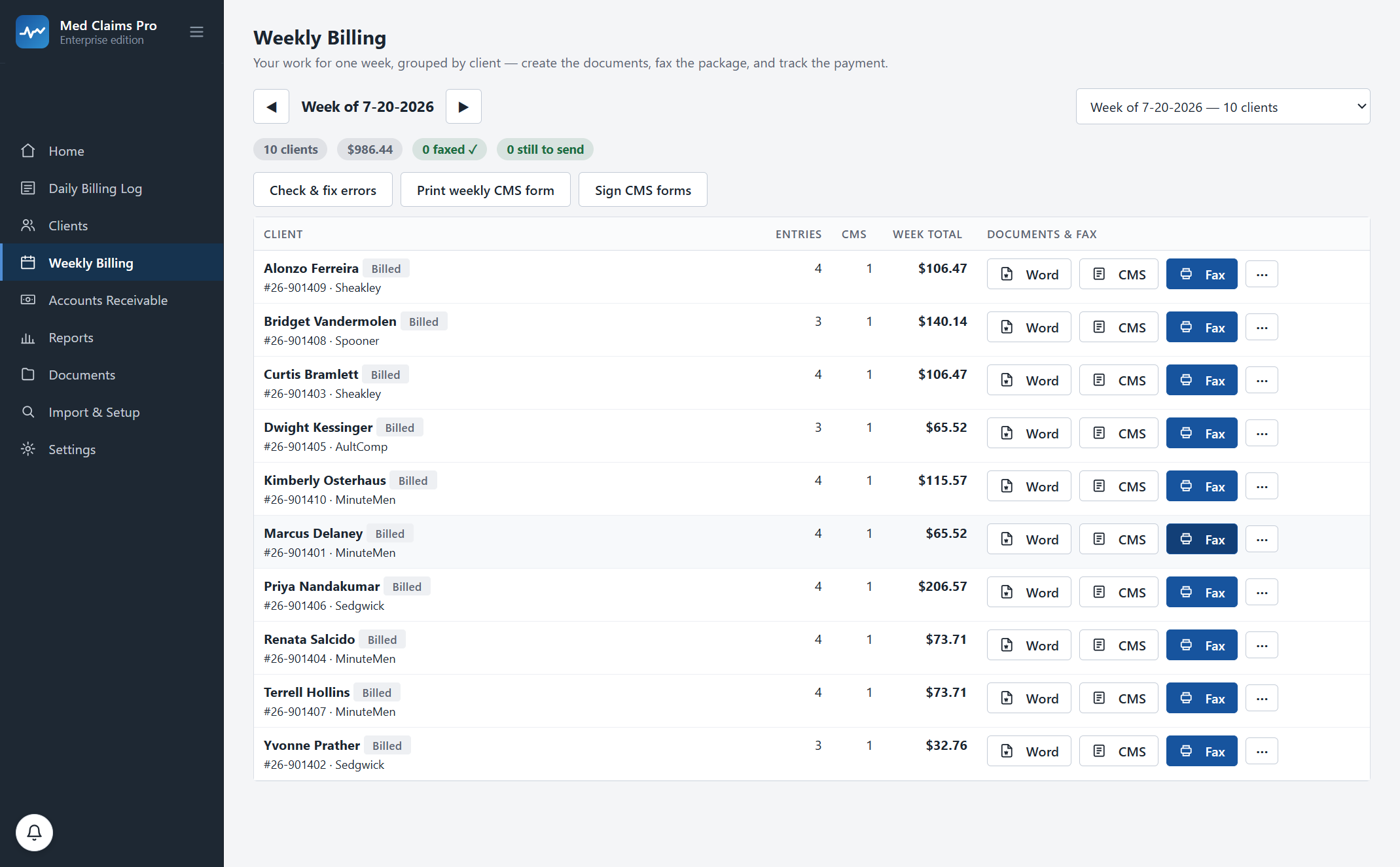
Weekly Billing — week of 7-20-2026 · 28 clients · $2,987.33
| Client | MCO | Entries | Forms | Week total | Documents & fax |
|---|---|---|---|---|---|
| Doe, John A. | MinuteMen | 5 | 1 | $180.18 | Word CMS Fax |
| Doe, Robert A. | MinuteMen | 7 | 2 over 6 lines | $182.00 | Word CMS Fax |
| Doe, Jane R. | MinuteMen | 4 | 1 | $73.71 | Word CMS Fax |
| Doe, Mary A. | Sedgwick | 4 | 1 | $141.39 | Word CMS Fax |
| Public, Jane D. | Sheakley | 5 | 1 | $107.38 | Word CMS Fax |
| … and 23 more clients billed this week — 28 in all, $2,987.33 | |||||
A week past six lines becomes form A plus form B on its own — and every form becomes its own receivable row.
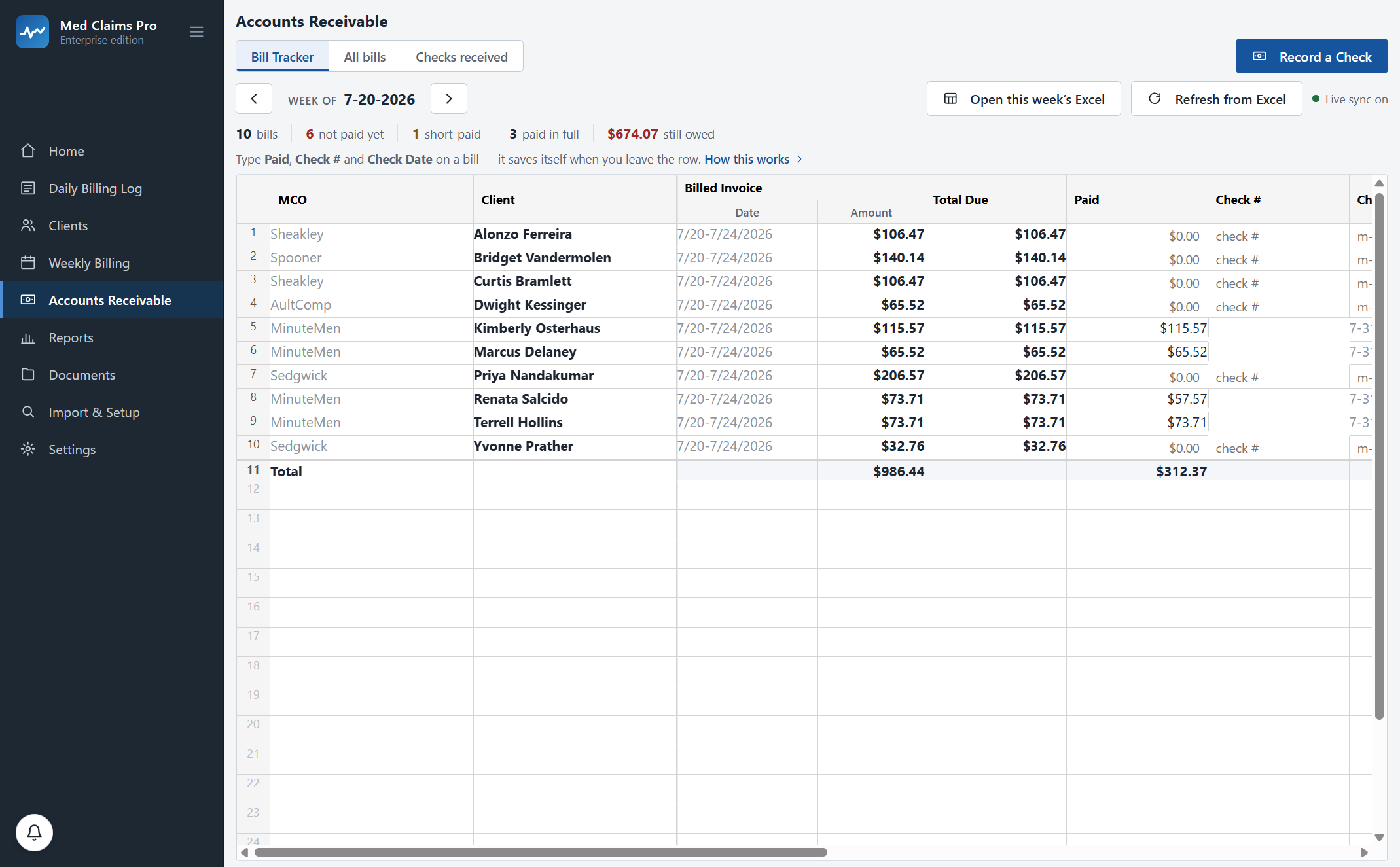
| MCO | Client | Billed | Paid | Check # | Status |
|---|---|---|---|---|---|
| MinuteMen | Doe, John A. | $180.18 | $180.18 | 418702 | Paid ✓ |
| MinuteMen | Roe, Richard T. | $81.90 | $81.90 | 418702 | Paid ✓ |
| MinuteMen | Doe, John P. | $33.76 | $33.76 | 418702 | Paid ✓ |
| MinuteMen | Doe, Jane R. | $73.71 | $57.57 | 418702 | Short paid — $16.14 |
| MinuteMen | Doe, Richard A. | $148.33 | $139.89 | 418702 | Short paid — $8.44 |
| Sedgwick | Doe, Jane C. | $40.95 | — | — | Waiting · 11 days |
| … and 22 more bills this week — one MinuteMen check (418702) covered 16 claimants, 3 came back short | |||||
One MinuteMen check, sixteen claimants. You record the check once; it lands on every bill it touches — and flags the three it came up short.
Doe, Jane R. · 26-901404 · week of 7-20-2026 · billed $73.71, paid $57.57
| Line | Code | Units | Billed | Paid | Gap |
|---|---|---|---|---|---|
| 1 | W3220 | 0.1 | $8.19 | $8.19 | — |
| 2 | W3207 | 0.1 | $8.19 | $8.19 | — |
| 3 | W3230 | 0.2 | $16.38 | $16.38 | — |
| 4 | W3235 | 0.5 | $40.95 | $24.81 | $16.14 |
Rebill packet, assembled: Original CMS-1500 Tracking log for 7-20 EOB page Fax to MinuteMen
Line 4 came back reduced. The gap is arithmetic, not memory — and it stays on the follow-up list until it is paid or you close it.
Waiting for payment — aging by MCO
| Bucket | Amount | Oldest | |
|---|---|---|---|
| 0–30 days | $2,847.11 | Sedgwick | |
| 31–60 days | $1,608.39 | Spooner | |
| 61–90 days | $122.85 | AultComp |
Worked, billed, paid, and owed stay strictly separate — nothing is ever counted twice.
Your MCOs, carriers, and TPAs — whichever ones you actually bill — are set up during onboarding.
W-code rates shown ($81.90 at Level 1, $84.40 on the W2 suffix at Level 2, and $91.00 for the assessment code) are Ohio BWC voc-rehab fee-schedule rates, current as of July 2026 — verify with Ohio BWC. The full W-code table →
How a billing week runs.
The same five steps you do by hand today — except each one hands off to the next by itself. If you use Excel and Outlook, you are already overqualified for it.
Type the work as it happens
Client, code, minutes, note. The rate, the claim number, the level suffix and the payer fill themselves, and your daily Excel file writes itself as you go — same template, same columns, still openable in Excel.
The documents build themselves
The weekly tracking log per client, in your Word template. The claim forms with the right payer header, the right units in box 24G, and automatic overflow to B and C forms past six lines. Filed into your folders, named your way.
Send it with proof
The packet goes out the way that payer takes it — faxed from your own RingCentral account, uploaded to its portal, or printed and mailed. The software assembles the packet and writes the cover text; RingCentral renders the cover page itself. A dated submission record, carrying the fax message id, files itself into that client’s Fax Confirmations folder next to the bill it belongs to, and you drop the carrier’s own confirmation page in beside it.
Record the check once
One MCO check covers sixteen claimants. Tick the bills it pays; the amounts pre-fill from the balances. Anything short is flagged with the exact gap and the original form attached, ready to rebill.
See the whole business
Worked, billed, paid, owed — by client, payer, and code, with an aging list that names who is sitting on your money and for how long. The follow-up list writes itself.
The check came. It covered sixteen claimants. Three of them short.
You would catch it eventually — around 11 p.m., cross-referencing the EOB against your spreadsheet, one claimant at a time. Med Claims Pro catches it the moment you record the check: every line compared to what you billed, every gap flagged in dollars and cents, every rebill packet assembled with the original claim attached. Nothing slips to “I’ll chase it later.”
Sixteen dollars is not the point. Four short-paid lines a week, across a caseload of thirty, for a year, is the point — and it is the money that goes missing quietly, because a short-pay looks exactly like a payment until somebody does the subtraction.
Every state runs workers’ comp its own way.
Ohio bills MCOs in W-codes by fax. Washington bills L&I in six-minute MARFS units against referral caps. Minnesota QRCs invoice carriers by the hour and file R-forms through Campus. The codes, forms, and payers change; your week does not. Yours are configured during onboarding.
Each is configured to that state’s codes, forms and payers during onboarding — included in every plan, in your first week.
Two jobs. One of them is probably yours.
Vocational rehab professionals
VRC, VRCM, QRC, rehabilitation supplier, rehabilitation practitioner, vocational counselor — if you bill a workers’-comp payer for your time, this was built around your exact week: the 0.1-unit grid, the weekly tracking log, the CMS-1500 and its B form, the fax confirmation, the receivable.
Nurse case managers
Field or telephonic: log the visit, the call, the wait time and the miles once, and the activity grid, the weekly narrative log and the receivables build themselves — with aging by payer in 30-day buckets. Where the carrier takes a CMS-1500, the software fills it.
Multi-counselor firm? What works for a firm today, and what does not →
Two more things, before you spend fifteen minutes on a demo. It is Windows desktop software — no Mac build, no browser version. And it is one person at a time: your billing database sits on your own machine, so a second specialist means a second copy with their own records, not a second login to yours. Both are on the pricing page too, because finding out late is worse than not calling.
Your client data never touches our servers.
Every claim, note, and document lives in a database on your computer, backed up automatically on every launch, exportable any time. Our server holds your license — nothing else. We could not read your case files if we wanted to.
It is on your computer
All claims data lives on your machine, backed up automatically every time the software opens. You own it, you can export it, and it works with the internet off.
Documents stay yours
The Excel, Word, and PDF files it writes go straight into your own Documents folders — under your control, synced only where you choose to sync them.
Never held hostage
Cancel and the software goes read-only: you keep viewing, printing, and exporting everything, in your formats, for as long as you like. No export fee.
If we disappeared tomorrow
Your database and every document it wrote are already on your computer, in ordinary Excel, Word and PDF files, in your own folders. Nothing you have depends on us still being here to open it.
One Ohio voc-rehab practice. Every screen came from her week.
I used to lose my whole morning retyping the same numbers into a log, a Word report, and the claim form — then again into a spreadsheet to track it. Now I type it once and everything is done.
Her numbers
- Injured workers billed
- About 30 a week, across several MCOs.
- Activities logged
- 30–40 a day — entered once, not four times.
- Daily paperwork
- 4–8 hours, down to minutes — her own estimate, not a stopwatched measurement.
- Her tracking-log template
- Reproduced from her own .docx — her headings, her spacing, her column order — not a lookalike we designed.
One customer, named honestly: this is the practice the software was built inside, and it is the only customer we quote. We will not invent more.
Flat monthly. Not a percentage of what you collect.
A billing service at 6% of a $13,600 book is $816 a month — and it still does not write your tracking logs. Every plan includes onboarding: your templates, your folders, your payers, your state’s codes.
Forms
- Clients, claim numbers, payers and folder trees
- The daily billing log — 0.1 units, your codes and rates, your own Excel file
- CMS-1500 filled from the record, with A/B/C overflow
- Print the whole week’s claim forms in one job
Professional
- Everything in Forms
- Weekly Word tracking logs on your template, plus error checking
- Accounts receivable, aging, one check across many claimants
- Short-pays flagged to the penny; fax with the confirmation filed
Firm
- Professional for each person in the practice
- One invoice, one setup, one number to call
- A shared caseload across users is in development — not sold as shipping
14-day free trial, no card. Sixty-day money-back guarantee. No contracts. Windows PC, one person at a time. Cancel and the software goes read-only — your records stay yours.
See your own week run itself.
Fifteen minutes, your state’s codes on screen and a caseload like yours — we load them before the call. Or start the trial and bring one real week of your own files; watch it import.
Or just call — a person answers. (302) 202-3172 · admin@onservice.us
Questions, answered.
Is my client data on your servers?
No. Claims, notes, and documents live in a database on your own computer, backed up automatically every time the software launches, and exportable any time. Our server holds your license record and nothing else — we could not read your case files if we wanted to. How that works →
What happens if I cancel?
The software goes read-only. You keep viewing, printing, and exporting everything, in your own formats, for as long as you like. No hostage data, no export fee, no contract to get out of.
Will it really match my templates and folders?
That is what setup is for. Your Word and Excel templates, your folder tree, your file naming, your payers, and your state’s codes are configured in your first week — included in every plan. The first customer’s tracking log came out matching her own template heading for heading. One thing to know up front: during the 14-day free trial you get the standard Ohio templates — yours are built with you once you start.
My state isn’t Ohio. Does it work for me?
The week is the same everywhere; the codes, forms, and payers change. Ohio ships configured today — its W-code families, current rates and MCO payer blocks are already in the software. Every other state’s codes, forms and payers are set up with you during your first week, and the activity grid, the weekly narrative log and the receivables work the same way in all of them. Find your state →
I’m not technical. How does setup work?
If you use Excel and Outlook, you are overqualified for the grid. We install it, bring in a real week of your existing files so you can see your own data on screen, and configure your templates with you. And there is a phone number — (302) 202-3172 — with a person on it.
Does it replace my biller, or my spreadsheets?
Your spreadsheets stay: the daily log and the Bill Tracker are still Excel files in your own folders, written for you instead of by you. A billing service does not write your weekly tracking logs or your CMS-1500s, and at 6% of the $13,600 a month our first customer bills, it costs $816. This is $299, flat.