Massachusetts OEVR provider billing —
the IWRP, invoiced.
OEVR screens the injured worker, the insurer must then provide vocational rehabilitation, and you bill against an approved Individual Written Rehabilitation Program under 452 CMR 4.00 — with the DIA Trust Fund standing behind the cases where the insurer does not.
The facts, before the pitch.
How billing works in Massachusetts
- Who you bill
- The insurer.
- What you send
- Invoice against an approved IWRP.
- The channel
- Direct.
- Fee basis
- No published rate we have verified. Ask the Department of Industrial Accidents (DIA) — Office of Education and Vocational Rehabilitation (OEVR) before anyone quotes you one — including us.
- The clock
- Not a deadline we have verified for Massachusetts. Ask the Department of Industrial Accidents (DIA) — Office of Education and Vocational Rehabilitation (OEVR), and read the payer’s own contract, before you rely on a date.
The system. The insurer must provide vocational rehabilitation after OEVR screening; plans are IWRPs, with Trust Fund backup.
Where the rules are written. 452 CMR 4.00.
The paperwork with its own name. IWRP — Individual Written Rehabilitation Program.
Configured for Massachusetts during onboarding — see it with your caseload. Your rates, your forms, your payers and your folder names are set up in your first week, included in every plan. What is on this page is what we would configure; we have not claimed a single Massachusetts customer anywhere on it.
Your week, in Massachusetts’ documents.
An approved plan is an authorization, and an authorization is a budget somebody has to watch.
- 8:40 a.m.OEVR screening outcome received. File opened against the IWRP.The plan becomes the authorization on the file, and the work bills against it from entry one.
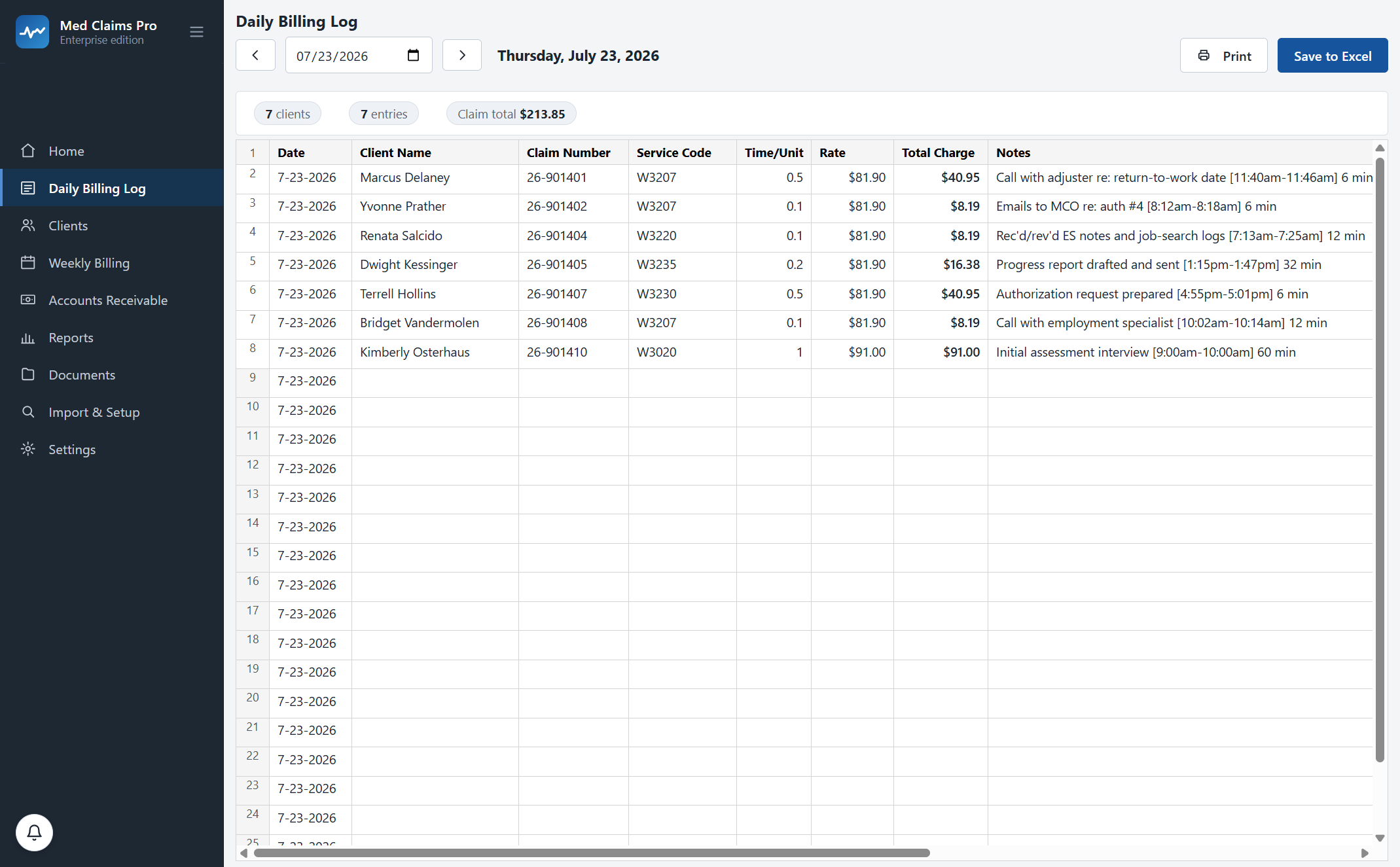
- 11:00 a.m.Training provider call and progress note.Two entries. The note is written once and shows up in the progress report without retyping.
- 2:15 p.m.Employer contact, then a status update to the insurer.Both billable, both timed, both landing in the same weekly narrative.
- 4:35 p.m.Invoice against the approved plan, itemized by date and activity.And a receivable, aging from the day it left rather than the day you remember it.
Every one of those rows is typed once, as it happens. The daily log writes itself as you go, the weekly narrative log builds in your own Word template, a CMS-1500 fills with the right units and the right payer block where a payer wants one — and where your state bills on its own form or an invoice, the dated, timed, priced lines that go on it come off the grid, and the receivable is tracked from the moment the bill leaves. The whole chain →
The IWRP is the authorization. Bill outside it and you are working for free.
Massachusetts gates the work behind an approved Individual Written Rehabilitation Program. Everything you do belongs to a plan, and everything you bill has to be inside one.
So the plan lives on the file as an authorization, the work is filed against it as you enter it, and what remains is visible on the grid instead of being reconstructed at invoice time. When the DIA Trust Fund is the payer instead of the insurer, that is a property of the file too — not something you remember while typing the bill.
The DIA publishes its certified provider list, which is how insurers find you. What happens after they find you is your paperwork’s problem.
Who pays you in Massachusetts.
The insurer pays, and the DIA Trust Fund backs the cases where nobody else will. Two payers with two very different rhythms, on one caseload.
Massachusetts payers
- Private carriers
- DIA Trust Fund
National carriers you will meet
- Travelers
- The Hartford
- AmTrust
- Zurich
- Chubb
- Berkshire Hathaway
- Liberty Mutual
- AF Group / Accident Fund
- Old Republic
- Great American
TPAs that send the referrals
- Sedgwick
- Gallagher Bassett
- ESIS
- Helmsman
- Broadspire
- CorVel
- TRISTAR
- CCMSI
- Athens Administrators
One check, many claimants. Whichever of these names is on the envelope, the check covers a dozen files at once. You record it once, tick the bills it pays, and anything short is flagged with the exact gap and the original form attached, ready to rebill. How that screen works.
Billing addresses and submission preferences go stale faster than any page can keep up, so we publish them only where we keep them current — today that is Ohio’s nine MCOs. Your Massachusetts payers and their submission preferences get set up during onboarding, from your own files.
Where the rules actually live.
Straight from the source
Outbound links to the Department of Industrial Accidents (DIA) — Office of Education and Vocational Rehabilitation (OEVR). We do not mirror agency documents — the agency’s copy is the one that counts.
How we keep this page honest
Every fact above is transcribed from the Department of Industrial Accidents (DIA) — Office of Education and Vocational Rehabilitation (OEVR) or the statute named, dated July 2026, and reviewed when the agency republishes. Where we have not verified something we say so rather than filling the gap.
Found something out of date? Tell us and we will fix it the same week: (302) 202-3172 or admin@onservice.us.
See a Massachusetts caseload run itself.
Fifteen minutes, Massachusetts’s codes on screen, with a caseload that looks like yours. Or start the trial and poke around on your own — no card, no contract.
There is a phone number and a person answers it: (302) 202-3172.
States that work like Massachusetts
Questions, answered.
What rate does Massachusetts pay?
We are not going to tell you, because we have not confirmed the current OEVR rate exhibits. Ask the DIA. Everything else on this page is sourced and dated; a rate we cannot cite is a rate we will not print.
Can it track work against an approved IWRP?
Yes. The plan is the authorization on the file, work is filed against it as you enter it, and what remains is on screen rather than in your head.
What about Trust Fund cases?
The payer is a property of the file, so Trust Fund work and insurer work never end up on the same bill and each has its own receivable and aging clock.
Do I have to change my invoice format?
No. Onboarding configures your invoice, your folders, your naming and your payers in the first week; it is included in every plan.
Is anything of mine stored on your servers?
No. The database is on your computer and the documents are in your folders. Our server holds your license.
See your own week run itself.
We load your state’s codes before the call, so you are looking at a caseload like yours inside the first two minutes — not a slide deck.