Washington vocational rehab billing —
MARFS Chapter 25, without the retyping.
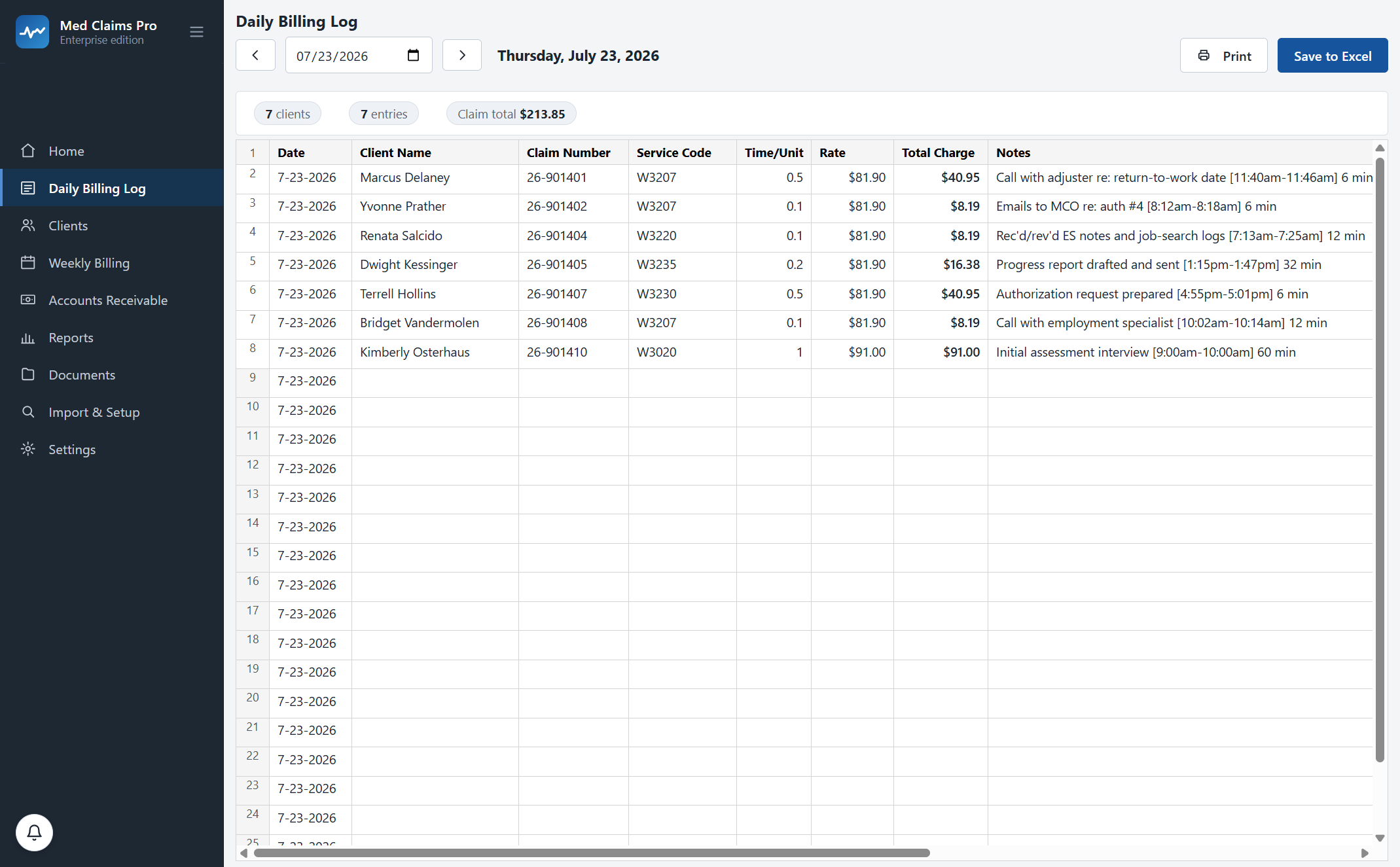
You bill L&I in six-minute units under MARFS Chapter 25 — 0810V for VRC time at $11.05 a unit — against referral caps you are expected to track yourself, with reports that travel with the bill. Med Claims Pro runs that trail from one daily grid: the activity log, the unit math, the report packet, the receivable.
The facts, before the pitch.
How billing works in Washington
- Who you bill
- L&I on State Fund claims, or the self-insured employer / TPA.
- What you send
- L&I vocational billing under MARFS Chapter 25, in six-minute units.
- The channel
- Provider billing through My L&I; referrals and outcomes through VocLink Connect.
- Fee basis
- MARFS Chapter 25 vocational codes.
- The clock
- Not a deadline we have verified for Washington. Ask the Washington State Department of Labor & Industries (L&I), and read the payer’s own contract, before you rely on a date.
- The ceiling
- Per-referral maximums — an Ability-to-Work Assessment referral caps near $7,776. Track your burn-down or eat the overage.
The system. Monopolistic state fund, plus self-insured employers and their TPAs.
Where the rules are written. WAC 296-19A (vocational provider registration; application F252-088-000).
The paperwork with its own name. F252-088-000 vocational provider application.
Electronic billing. Portal billing through My L&I. Med Claims Pro builds the bill and the packet and files the confirmation; direct electronic submission is roadmap, not a shipped feature.
Configured for Washington during onboarding — see it with your caseload. Your rates, your forms, your payers and your folder names are set up in your first week, included in every plan. What is on this page is what we would configure; we have not claimed a single Washington customer anywhere on it.
Your week, in Washington’s documents.
Ability-to-Work Assessment interviews, job analyses, employer contacts, plan development on Option 2 timelines — every one a coded, timed entry that has to land inside a cap.
- 8:20 a.m.AWA interview with the injured worker, fifty minutes.Eight units of 0810V at $11.05, priced and attached to the right referral before you are out of the parking lot.
- 11:05 a.m.Two employer contacts and a job analysis write-up.Three rows, three unit counts, three dollar figures — all done as you type, not on Sunday.
- 2:30 p.m.Plan development against Option 2 timelines.Filed to the right referral, so when you add up what is left of a cap near $7,776 you are adding up entries that are already dated, coded and priced.
- 4:45 p.m.The report has to travel with the bill.Report and bill leave together; the confirmation files itself into the claimant’s folder.
- 9:00 p.m.Your own tracker, then L&I’s billing, then reconciling both against the cap.That is the shift this deletes. One entry made it all three.
Every one of those rows is typed once, as it happens. The daily log writes itself as you go, the weekly narrative log builds in your own Word template, a CMS-1500 fills with the right units and the right payer block where a payer wants one — and where your state bills on its own form or an invoice, the dated, timed, priced lines that go on it come off the grid, and the receivable is tracked from the moment the bill leaves. The whole chain →
MARFS Chapter 25, in six-minute units.
| What you bill | Rate |
|---|---|
| 0810V — VRC time | $11.05 per 6-minute unit (≈$110.50/hr, 2026) |
Current as of July 2026 — verify with the Washington State Department of Labor & Industries (L&I).
Intern and forensic rates differ from the VRC rate. L&I republishes MARFS each July, and a rate change arrives as a data update while historical entries keep the rate they were billed under.
Rates move. When they do it arrives as a data update, and every activity you already billed keeps the rate it was billed under — which is the only way a rate change survives an audit.
A referral cap is a budget you can only see by adding it up.
An Ability-to-Work Assessment referral caps near $7,776. Nothing stops you working past it — the only thing that stops you is arithmetic you do by hand, usually after the fact, usually in a spreadsheet built for a different referral.
The software does not track that cap for you today. There is no authorized / used / remaining field in it, and we are not going to tell you there is on the page that argues this is your biggest money leak. What it does is make the addition possible: every unit is dated, coded, priced and attached to its referral as you enter it, so the running total is a filter over records that already exist rather than a reconstruction at invoice time.
State Fund and self-insured claims sit side by side in the same receivables list, because you carry both and they pay differently.
Who pays you in Washington.
Washington is one of four monopolistic states. State Fund claims are billed to L&I; everything else goes to a self-insured employer or its TPA. Two different payers on one caseload, with two different habits about paying on time.
Washington payers
- Washington L&I (State Fund)
- Self-insured employers and their TPAs
National carriers you will meet
- Travelers
- The Hartford
- AmTrust
- Zurich
- Chubb
- Berkshire Hathaway
- Liberty Mutual
- AF Group / Accident Fund
- Old Republic
- Great American
TPAs that send the referrals
- Sedgwick
- Gallagher Bassett
- ESIS
- Helmsman
- Broadspire
- CorVel
- TRISTAR
- CCMSI
- Athens Administrators
One check, many claimants. Whichever of these names is on the envelope, the check covers a dozen files at once. You record it once, tick the bills it pays, and anything short is flagged with the exact gap and the original form attached, ready to rebill. How that screen works.
Portal routes and billing addresses go stale faster than any page can keep up, so we publish them only where we keep them current — today that is Ohio’s nine MCOs. Your Washington payers and their submission preferences get set up during onboarding, from your own files.
Where the rules actually live.
Straight from the source
Outbound links to the Washington State Department of Labor & Industries (L&I). We do not mirror agency documents — the agency’s copy is the one that counts.
How we keep this page honest
Every fact above is transcribed from the Washington State Department of Labor & Industries (L&I) or the statute named, dated July 2026, and reviewed when the agency republishes. Where we have not verified something we say so rather than filling the gap.
Found something out of date? Tell us and we will fix it the same week: (302) 202-3172 or admin@onservice.us.
See a Washington caseload run itself.
Fifteen minutes, Washington’s codes on screen, with a caseload that looks like yours. Or start the trial and poke around on your own — no card, no contract.
There is a phone number and a person answers it: (302) 202-3172.
States that work like Washington
Questions, answered.
Does it know the 2026 MARFS rates?
Yes — 0810V for VRC time at $11.05 per six-minute unit, about $110.50 an hour. Current as of July 2026; verify with Washington L&I, which republishes MARFS each July. Rate changes ship as data updates and never rewrite what you already billed.
Can it track per-referral caps?
No — not today, and that is the honest answer on the page that calls the cap your biggest money leak. The software holds no authorized / used / remaining figure and will not warn you when a referral is running out. What it holds is every unit, dated, coded, priced and attached to its referral as you typed it, so totalling what you have used against a $7,776 Ability-to-Work Assessment ceiling is arithmetic over real records instead of a reconstruction. If per-referral caps are the reason you would buy this, say so on the call rather than finding out afterwards.
Do you submit through My L&I or VocLink Connect for me?
No, and we will not pretend otherwise. My L&I is where provider billing goes and VocLink Connect is where referrals and outcomes travel. Med Claims Pro builds the bill, the report packet and the receivable and files your proof; portal submission is on our roadmap, not in the product.
Self-insured employers and their TPAs too?
Yes. L&I and self-insured payers live side by side, each with its own aging, so you can see which of the two is actually slow.
Is my claim data in a cloud?
No. The database is on your computer and the documents are in your own folders. Our server holds your license and nothing else.
See your own week run itself.
We load your state’s codes before the call, so you are looking at a caseload like yours inside the first two minutes — not a slide deck.