daisyBill is very good at workers’ comp billing.
It has never heard of W3207.
This is the fair comparison, including the parts that do not flatter us. daisyBill is the closest thing this industry has to a category leader — deep, credible, and better than we are at several things we will name below. It is also built for a clinic’s front desk, and you are running a counselor’s caseload.
What daisyBill actually is, described properly.
A workers’-comp billing and revenue-cycle platform with exact state fee-schedule calculators, verified electronic delivery to the right clearinghouse or payer, and document-with-bill attachments. Its signature feature is second-review and appeal automation. The company reports that its users have recovered more than $100 million in underpayments through it.
That is their number, reported by them, and we do not claim any part of it. We quote it because it settles an argument we would otherwise have to make from scratch: underpayment in workers’ comp is a real, measurable, recoverable wound. A company built a business on catching it. If you have ever wondered whether the $16.14 is worth chasing, that is your answer, and it did not come from us.
Where it wins: California physician practices, surgery centers and third-party billers. It is deep, it is credible, and it is ready for the states that mandate electronic billing. If that describes your practice, this comparison ends here and you should buy daisyBill.
daisyBill, on the record
- What it is
- Workers’-comp billing and revenue-cycle platform.
- Price
- “Starting at $300/month,” volume-based, no contract. Its billing service starts around 3% of collections.
- Signature feature
- Second-review and appeal automation — a reported $100M+ recovered by its users.
- Built for
- California physician practices, surgery centers, third-party billers.
- Delivery
- Verified electronic delivery, document-with-bill (275) attachments, state fee-schedule calculators.
daisyBill pricing and feature facts as published by daisyBill; current as of July 2026 — verify with daisyBill. daisyBill is their trademark, not ours, and we have no relationship with them.
Three things daisyBill does better than we do. Today, plainly.
If a comparison page never concedes anything, it is an advertisement. Here is what we would tell you on the phone.
Electronic billing
daisyBill does verified electronic delivery to payers and clearinghouses, with proof of receipt. We do not, yet. Today we do fax with a filed confirmation, a portal upload you do yourself, and paper — which is the standard channel for Ohio MCO billing and gives you timely-filing evidence. It is not universal: providers must submit electronically in Texas, Minnesota, North Carolina, Tennessee, Virginia, New York and Colorado, a Minnesota QRC files through Work Comp Campus and a Washington claim goes through My L&I. In those states daisyBill can e-bill and we cannot yet. Direct e-billing for mandate states is on our roadmap, and we will say “roadmap” until the day it ships.
Second review and appeals
Their appeal automation is the deepest tooling of its kind in this industry, and it is why their recovery figure exists. We detect the short-pay to the cent, keep the original claim form and the log behind it as evidence, and age the balance. We do not file your state’s dispute for you. Automated reclaim packets are on the roadmap.
Physician-side breadth
Procedure coding, surgery center billing, clearinghouse routing across many states, third-party biller workflows at volume. That is their world and they are years into it. We have deliberately built none of it, because it is not your world.
And four things it was never built to do — because its buyer never asked.
Ohio BWC voc-rehab W-codes
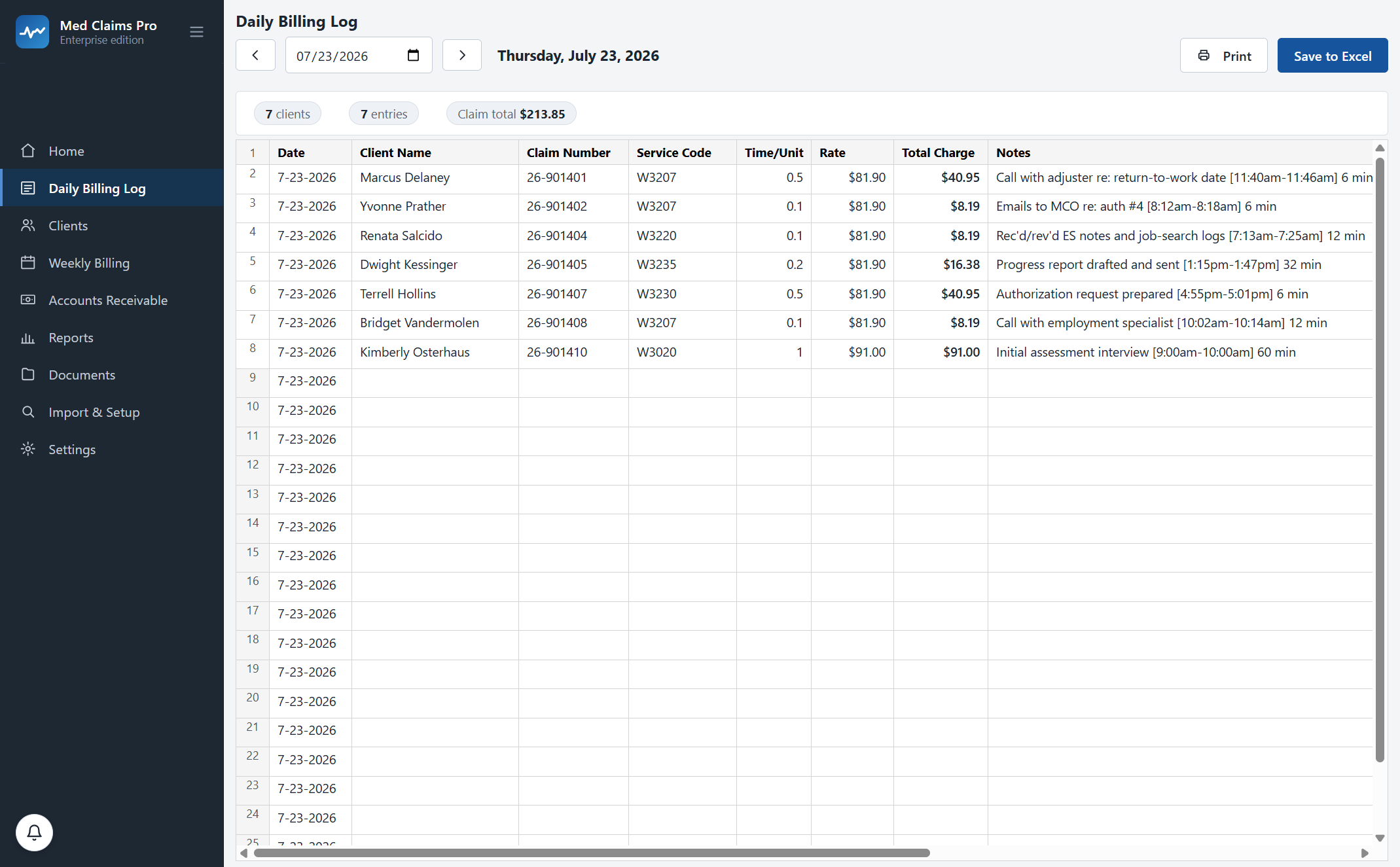
W3207 at Level 2, $84.40 a unit. W3220 for the notes you reviewed. W3235 for the progress report. W3020 for the assessment interview. Tenth-of-an-hour units, level suffixes, JR and SI and RAW case types, an October fee-schedule change every year, nine certified MCOs to bill by fax. None of that exists in a product built for California physician billing, and there is no reason it should.
Time-grid activity capture
Your billable unit is six minutes of your own attention, thirty to forty times a day. A billing platform starts from a completed encounter and asks what procedure was performed. It has no grid you live in from Monday to Friday, and no way to turn “4 minutes on the phone with the adjuster about auth #6” into a coded, priced line.
Weekly narrative tracking logs
In voc rehab the report travels with the bill. The weekly Client Tracking Log, in your Word template, in your headings, in the client’s folder, matching the claim form line for line. No workers’-comp billing platform writes narrative documents, because a physician practice does not need one written.
The case-management day
Case levels that change the code family. An MCO that changes mid-case. Closures folders. Which of your thirty injured workers has had no activity in eleven days. That is caseload management, and a billing platform correctly has no opinion about it.
The honest line: a front desk, or a caseload.
daisyBill is built for the person at the front of a clinic whose job is to get claims out and money in. This is built for the person carrying thirty injured workers whose job happens to include getting claims out and money in.
| daisyBill | Med Claims Pro | |
|---|---|---|
| Built for | California physician practices, surgery centers, third-party billers | Workers’-comp voc rehab and nurse case management |
| Starts from | A completed encounter to be billed | Six minutes of your time, coded as it happens |
| Ohio BWC W-codes | No | Yes — levels, units, case types, October rate changes |
| Time-grid activity capture | No | Yes — 0.1-unit rows, rate and extension as you type |
| Weekly narrative tracking log | No | Yes — your Word template, one click per client |
| CMS-1500 with B/C overflow | Yes | Yes — automatic at line seven |
| Electronic billing | Yes — verified delivery, their strength | Not yet — fax with filed proof, portal, paper. E-billing on the roadmap |
| Second review / appeal automation | Yes — a reported $100M+ recovered | Detection and evidence only. We flag the gap; we do not file the dispute |
| One check across many claimants | Payment posting, physician-style | Yes — allocate one MCO check across a dozen claimants in one screen |
| Where your data lives | Their cloud | A database on your own computer |
| Price | From $300/mo, volume-based, no contract | $49 or $299 flat, no contract |
daisyBill facts as published by daisyBill; current as of July 2026 — verify with daisyBill. Rows marked “No” mean the capability is outside the product’s scope, not that it was attempted badly.
Two clean answers, so nobody wastes a demo.
Buy daisyBill if…
You bill physician services, surgery center services or clinical procedures in workers’ comp — especially in California. You are a third-party biller working many payers at volume. Electronic billing to a mandate state is a requirement today, not a preference. Or fighting bill review and filing second reviews is the actual center of your job. In every one of those cases they are better at your work than we will ever be, and we would rather say it here than on a call.
Buy this if…
Your billable unit is your own time in tenths of an hour. A narrative report travels behind every claim form. You bill an MCO or a carrier or a TPA for a caseload of injured workers you know by name. Your week currently runs through a daily Excel log, a Word tracking log, a CMS-1500 and a Bill Tracker — four typings of the same six minutes. That is the exact week this was built around, inside a working Ohio voc-rehab practice.
And it arrives already shaped like your practice. daisyBill configures a fee schedule. During onboarding we configure Med Claims Pro to your exact formats, your folders, your payers and your state’s codes — your Word tracking-log template with your headings, your client folder tree and your file naming, your MCO list and your Ohio W-codes — so it fits the week you already run instead of asking you to change it.
If you are genuinely between the two, call and describe your week: (302) 202-3172. We will tell you honestly if the answer is them. Or see it against a caseload like yours — fifteen minutes, your state’s codes on screen.
The other alternatives: Excel and Word by hand · a 5–8% billing service · CMS-1500 form-fillers · All four side by side
Questions, answered.
Is Med Claims Pro a daisyBill alternative?
Only if you are in workers'-comp vocational rehabilitation or nurse case management. For physician-side workers'-comp billing, daisyBill is the stronger product and we would tell you so. The two overlap on the CMS-1500 and almost nowhere else: they start from an encounter to be billed, we start from six minutes of your time to be coded.
Does daisyBill support Ohio BWC voc-rehab W-codes?
No. It is built around physician and facility billing with state fee-schedule calculators for those services. Ohio’s voc-rehab code family — W3207, W3220, W3235, W3020, level suffixes, tenth-of-an-hour units, nine certified MCOs, an October fee-schedule update — is a different fee schedule for a different profession. Current as of July 2026; verify with daisyBill.
Is daisyBill cheaper than Med Claims Pro?
No. daisyBill starts at $300 a month and is volume-based; our Professional tier is $299 flat ($239 billed annually) and Forms is $49 ($39 a month billed annually). Neither has a contract. Price is a poor reason to choose between them though — the fit question is whether your billable unit is a procedure or your own time.
You do not have e-billing. Is that a dealbreaker?
It depends on your state. Ohio voc-rehab bills go to MCOs by fax, and the fax confirmation filed in the client folder is your timely-filing proof — that is the standard channel, not a workaround. If you are in a state that mandates electronic submission today, daisyBill can do it and we cannot yet. E-billing for mandate states is on our roadmap and we will announce it when it ships, not before.
What is the $100 million figure?
It is daisyBill’s own reported figure for underpayments its users have recovered through its second-review and appeal automation. It is their number, not ours, and we quote it for one reason: it proves that workers'-comp underpayment is worth real money to chase. Our own short-pay feature detects the gap and assembles the evidence; it does not file the dispute. How ours works →
Could I run both?
A multi-state practice could, though it is an unusual setup. The pattern is documentation, coding and caseload here, electronic submission and appeals there. If that is your situation, call and describe it — we will tell you plainly whether it is worth the double subscription.
See your own week run itself.
We load your state’s codes before the call, so you are looking at a caseload like yours inside the first two minutes — not a slide deck.