Thirty injured workers in a week.
Every activity typed four times.
A vocational rehab case manager in Ohio ran her whole billing operation by hand — a daily Excel log, a weekly Word tracking log per client, a CMS-1500 per claim, and a receivables workbook. The same six minutes of work, keyed four times. Med Claims Pro was built inside that practice. Here is what it measured, and what it did not.
Figures below are aggregated from the founding practice’s own 2026 billing files. No injured-worker information appears on this page or anywhere on this site.
Six steps, all by hand.
Every billable action — a six-minute call with an adjuster, a thirty-two-minute progress report, a job-site visit — started the same chain, and she walked the whole chain herself. The information never changed between steps. She was, in effect, being paid to copy her own numbers from one document into the next.
- Daily billing log. She typed each activity into an Excel sheet: date, client, claim number, service code, time in 0.1-unit increments, the rate looked up by hand, the charge multiplied out, and a note with the time range in brackets.
- Weekly client tracking log. At the end of the week she re-typed each client’s activities into a separate Word document — the narrative log the MCO expects behind the bill.
- CMS-1500. Then the same lines a third time onto the claim form, splitting onto a second and third form whenever a client ran past the form’s six service lines, and re-adding the totals on each one.
- Folders. Each client had a folder tree she created and maintained by hand — billing info, CMS 1500, emails, fax confirmations — named her way, and only her way.
- Fax packet. She assembled a cover sheet, the Word log and the CMS forms, faxed the packet to the MCO, and filed the confirmation — her only proof against Ohio’s one-year timely-filing clock.
- Accounts receivable. A fourth typing, into a Bill Tracker workbook, so she would know what was owed. When a check arrived she went back in to mark each bill paid, hand-flag anything short in a “Claim Rebilled” column, and set aside about 37% for taxes in a column she built herself.
Four copies of the same six minutes. On a heavy day the copying took four to eight hours — evenings and 5:30 a.m., after the actual counseling work was done.
One week of her caseload, in numbers.
| What we counted | The number |
|---|---|
| Injured workers billed in a single week | about 30 |
| Invoice line items that same week | about 35 — a busy week overflows onto second CMS-1500 forms |
| Billable activities logged per day | 30–40, in 0.1-hour units |
| Times each activity was typed, before | 4 — daily Excel log, weekly Word log, CMS-1500, receivables workbook |
| Billings, per month | about $13,600 — roughly $3,140 in a week, about $630 a working day |
| Annualized gross billings, one solo counselor | about $163,000 — $13,600 × 12, the same monthly figure used everywhere else on this site |
| Payer concentration | three of Ohio’s nine certified MCOs carried nearly all of it — about 65% / 19% / 15% |
| Daily paperwork time, before | 4–8 hours on a heavy day |
| Daily paperwork time, now | minutes — the entry itself, as the work happens |
Aggregated from the founding practice’s 2026 files, July 2026.
The codes and rates underneath those numbers
| Code family | What it covers | Rate per hour |
|---|---|---|
| W3007 · W3020 · W3025 · W3035 | Assessment and pre-plan services | $91.00 |
| W3207 · W3220 · W3230 · W3235 | Plan implementation, Level 1 | $81.90 |
| The same family with the W2 suffix | Plan implementation, Level 2 | $84.40 |
Ohio BWC vocational rehabilitation fee schedule, current as of July 2026 — verify with the Ohio Bureau of Workers’ Compensation. Rates change every October; the full W-code table is here.
She types it once, as it happens.
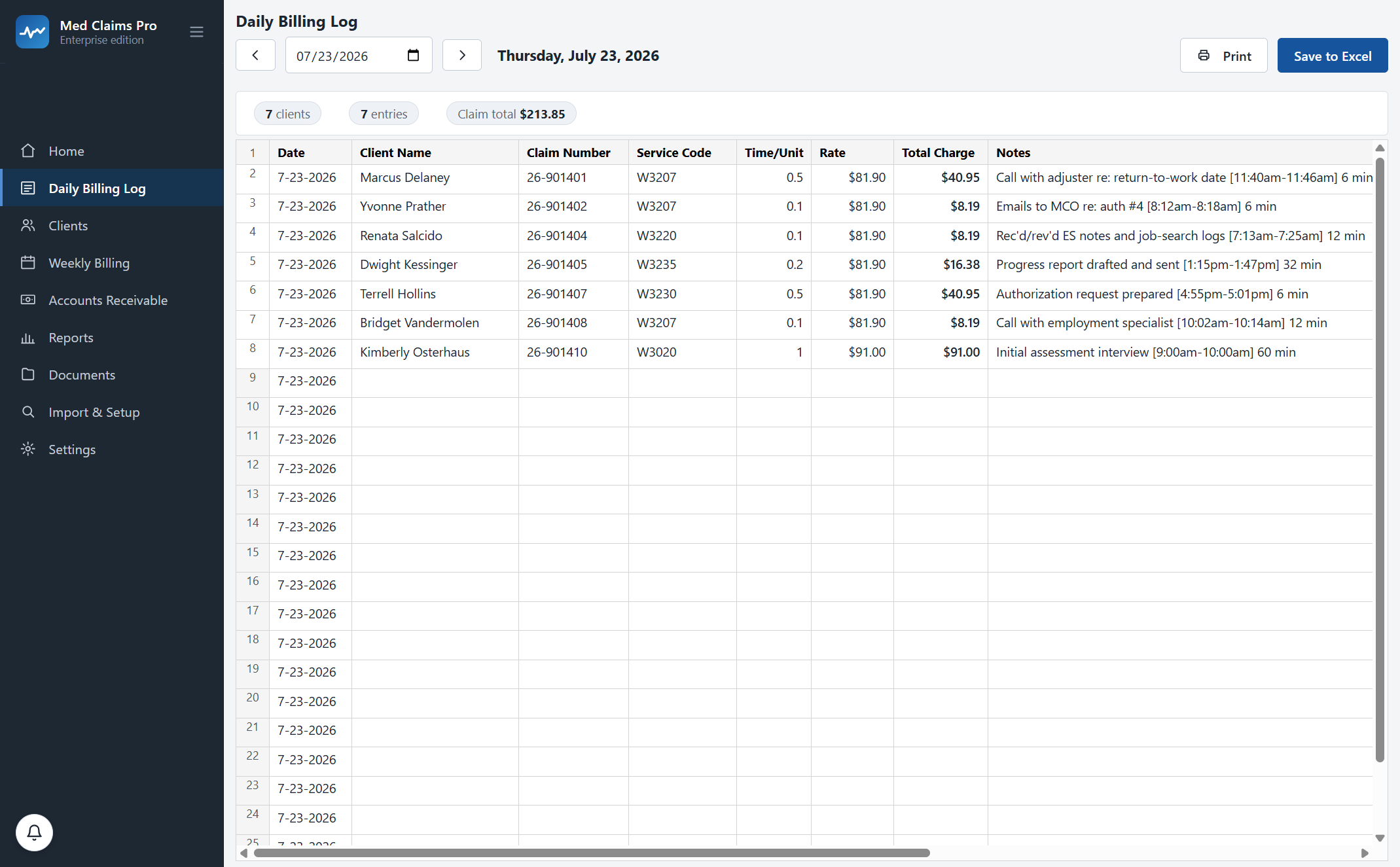
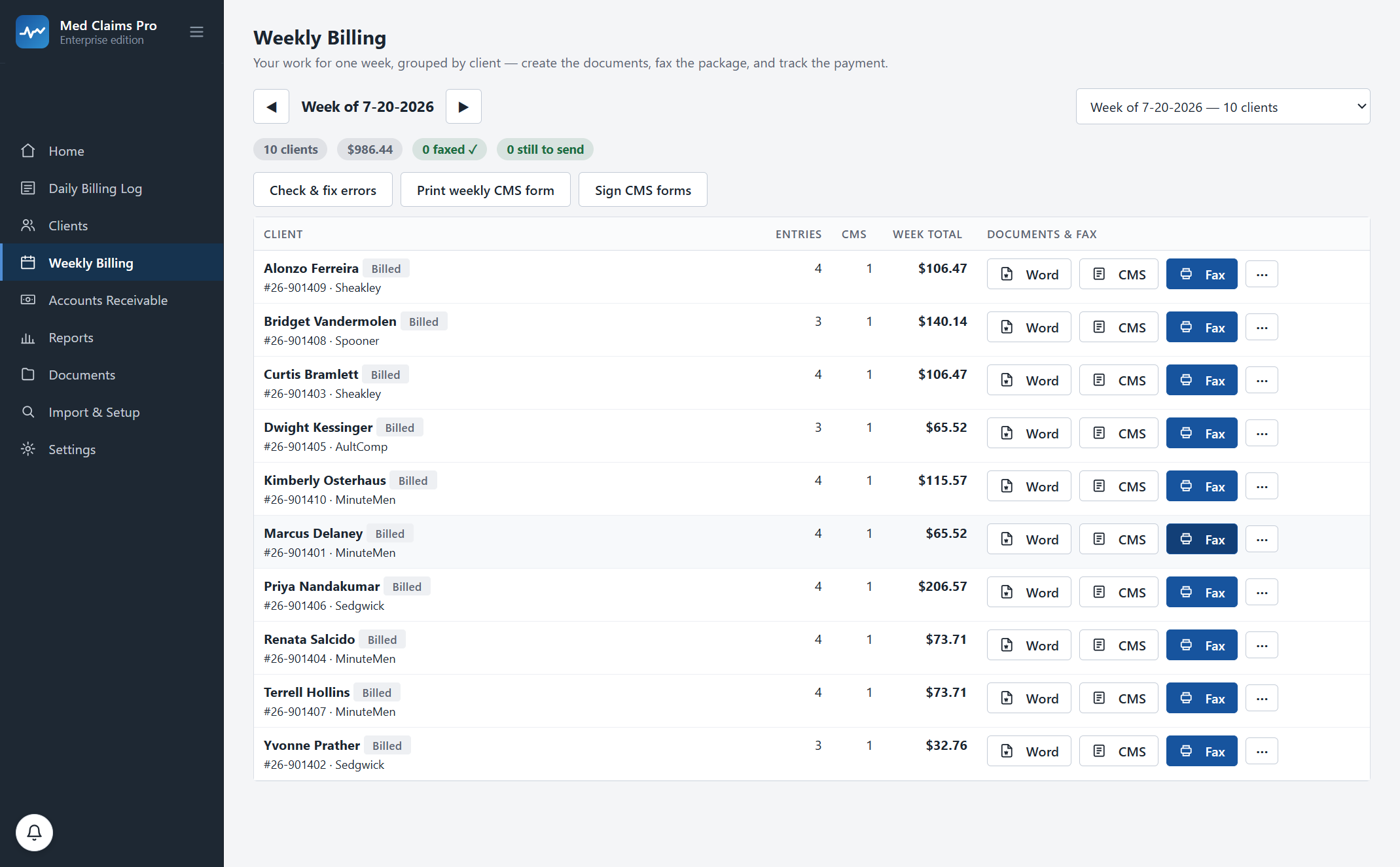
The daily grid mirrors the Excel sheet she already used — same columns, same rates, same order. It is the single source of truth. The rate fills itself, the charge calculates, the note keeps her bracketed time range, and the Excel file writes itself into her own folder where she can still open and edit it by hand.
The check came. It covered sixteen people. Three were short.
An MCO check does not arrive per claimant — it arrives per MCO, covering whoever it covers. She used to reconcile that against her Bill Tracker by hand, late, and flag shortfalls in a column she built herself. Now every line is compared to what was billed the moment the check is recorded, and the gap is on screen in dollars and cents with the original form attached for rebilling.
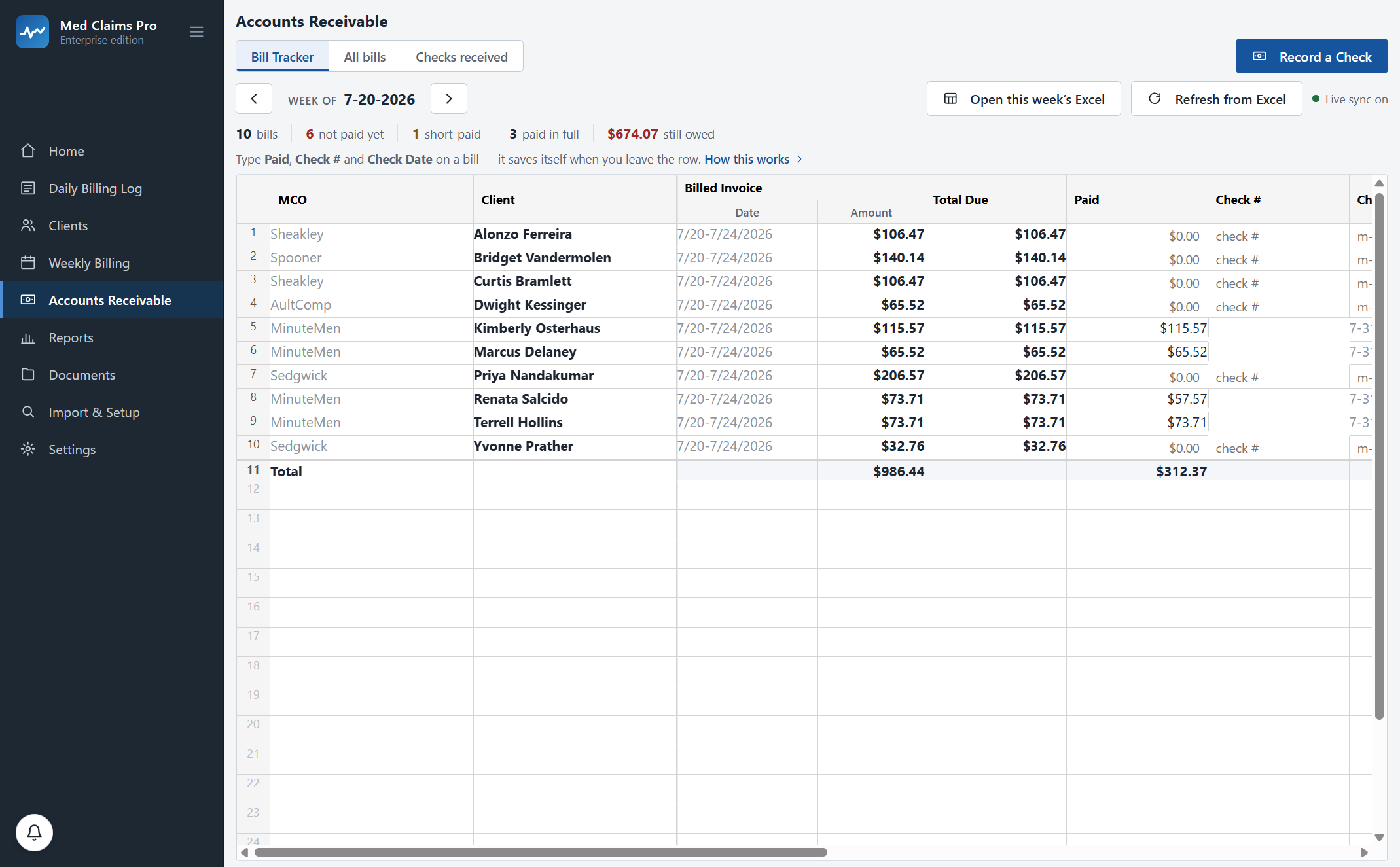
She was already doing short-pay recovery before the software existed — her workbook has a “Claim Rebilled” column and a second check-number and check-date column, built by hand, because underpayment is normal in this work. The software did not invent that job. It just stopped it depending on her attention at the end of a long day.
What the alternative would have cost her.
At about $13,600 a month of billings, the option she was actually weighing was a billing service at 5–8% of collections. Here is that comparison with the working shown.
The other number in the comparison is her own time, and we are not going to put a figure on yours. Whatever your own retyping hours come to, valued at the rates in the table above, is not a rounding error in a solo practice — it is the difference between a Sunday evening and a second shift.
“I used to lose my whole morning retyping the same numbers into a log, a Word report, and the claim form — then again into a spreadsheet to track it. Now I type it once and everything is done. It gave me my practice back.”
— Vocational rehab case manager, Ohio. Our first customer. Her name, her practice and her claimants stay out of this for the obvious reason; a reference conversation can be arranged once we have talked.
What this case study does not claim.
One customer, not a survey. There is exactly one practice behind every number on this page. We are not going to write “practices like yours save 10 hours a week” on the strength of a sample of one, and you should not trust anyone who does.
The hours are her estimate. Nobody stood behind her with a stopwatch. “Four to eight hours on a heavy day, now minutes” is how she describes it. The billings, the caseload, the activity counts and the payer mix are read from her files, not estimated.
We have not published a recovered-short-pay total. The feature flags gaps and assembles the rebill; we have not yet run long enough to state a dollar figure we would stand behind. When there is one, it goes here with the date it was measured.
Ohio is the state we have lived in. The workflow is the same everywhere — log time, document it, bill it, chase it — but Washington’s MARFS units and Minnesota’s QRC invoices are configured during onboarding, not proven by this practice. Your state’s facts are here.
Different state. Same week.
Yours is not her practice. Different payers, different codes, different folder names, maybe an invoice instead of a CMS-1500. That is what onboarding is for: we configure your templates, your folders, your payers and your state’s codes in your first week, and it is included in every plan. What does not change is the shape of the week — the activity, the document, the claim, the check, the one that came up short.
Or call (302) 202-3172. No card. No contract. Your data stays on your computer.
Questions, answered.
Who is the customer in this case study?
A solo vocational rehabilitation case manager in Ohio, BWC-enrolled, billing MCOs in W-codes on CMS-1500s. She is our first customer, and Med Claims Pro was built inside her practice. Her name and her claimants are not published, and never will be.
Is this your only customer?
Yes. We would rather say that plainly than imply a roster we do not have. One deep, real, measured practice is the proof we can offer today — along with a phone number, a 14-day free trial with no card, and a sixty-day money-back guarantee if it does not do for you what it did for her.
Where do the numbers come from?
Her own 2026 billing files — the daily Excel logs, the weekly documents, and the Bill Tracker workbook — aggregated for a July 2026 market study. Caseload, activity counts, billings and payer mix are counted from the files. The hours-per-day figure is her own description of her workload before and after.
My state is not Ohio. Does any of this transfer?
The chain does: log the activity once, generate the weekly narrative log, generate the claim form where one is used, send it with proof, track the receivable, catch the short-pay. The codes, forms and payers are what change, and Ohio is the only one that ships configured — yours is set up with you in your first week. See your state for how billing actually works there.
What did she have to change about how she works?
Her folder names, her Word template, her Excel layout and her filing all stayed as they were — the software was fitted to them. What changed is that the second shift stopped.
Can I speak to her?
A reference conversation can be arranged after we have talked, with her permission and on her schedule. We do not hand out a customer’s phone number to fill a form.