District of Columbia vocational rehab billing —
§32-1507, and the fund behind it.
D.C. Code §32-1507 puts the duty on the employer to furnish vocational rehabilitation, DOES administers the system, and a special fund stands behind the cases where nobody else will pay. Most practitioners here also carry Maryland and Virginia files, which is three sets of rules in one week.
The facts, before the pitch.
How billing works in District of Columbia
- Who you bill
- The employer or carrier.
- What you send
- Invoice.
- The channel
- Direct.
- Fee basis
- No published rate we have verified. Ask the DC Department of Employment Services (DOES) before anyone quotes you one — including us.
- The clock
- Not a deadline we have verified for District of Columbia. Ask the DC Department of Employment Services (DOES), and read the payer’s own contract, before you rely on a date.
The system. The employer must furnish vocational rehabilitation; DOES administers, with special-fund backup.
Where the rules are written. D.C. Code §32-1507.
Configured for District of Columbia during onboarding — see it with your caseload. Your rates, your forms, your payers and your folder names are set up in your first week, included in every plan. What is on this page is what we would configure; we have not claimed a single District of Columbia customer anywhere on it.
Your week, in the District’s documents.
A compact jurisdiction whose practitioners rarely work only one jurisdiction.
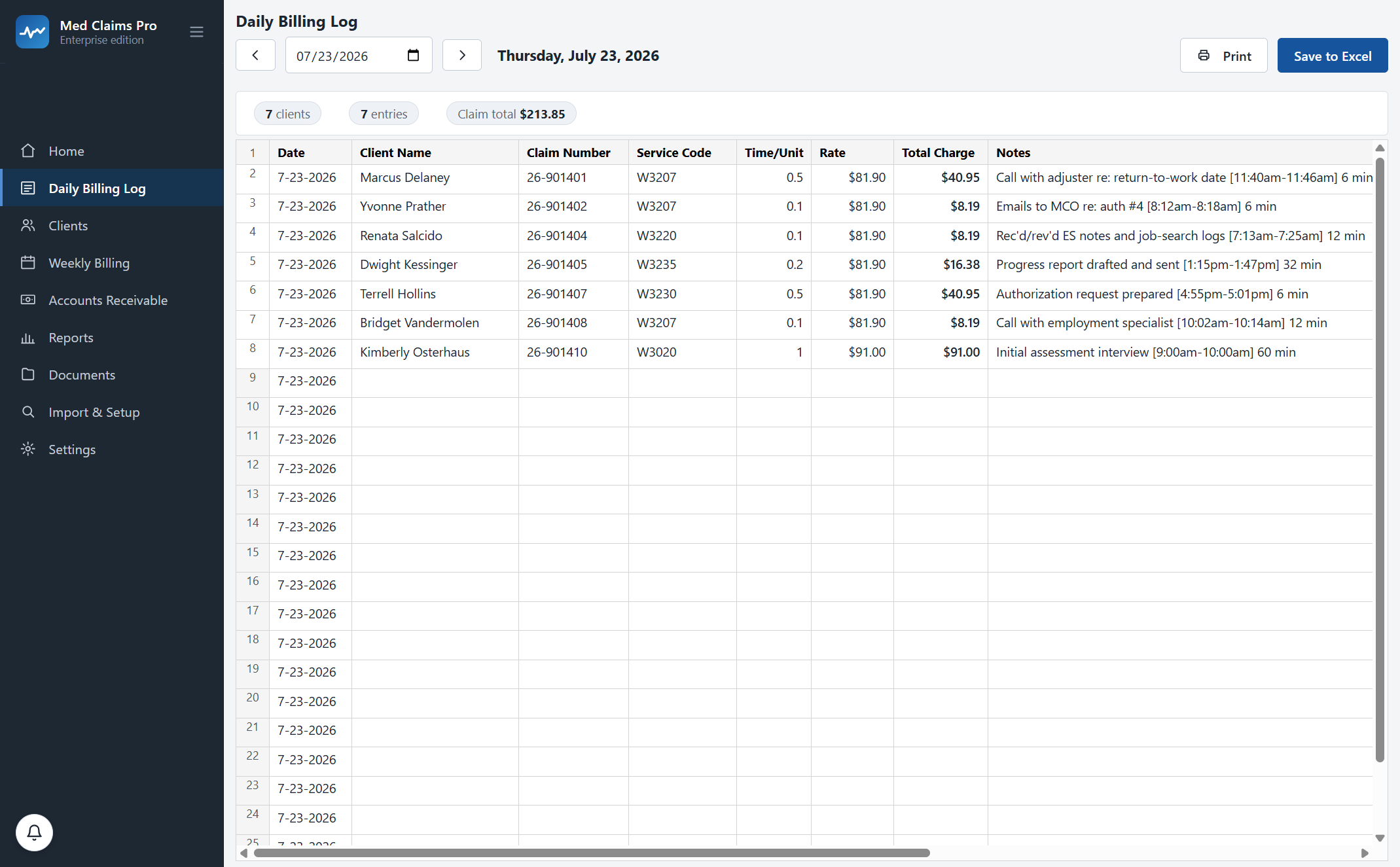
- 8:15 a.m.DC file: vocational assessment interview.The rules that apply are a property of the claim, not of your morning.
- 10:40 a.m.Maryland file next, then a Virginia CMS-1500 to finish.Three jurisdictions, three sets of payer expectations, one grid underneath.
- 1:30 p.m.Employer contacts and a progress note.Written once, reused in the report, not retyped into it.
- 4:25 p.m.Invoices out to three payers in three jurisdictions.Three receivables, three aging clocks, one list on Tuesday morning.
Every one of those rows is typed once, as it happens. The daily log writes itself as you go, the weekly narrative log builds in your own Word template, a CMS-1500 fills with the right units and the right payer block where a payer wants one — and where your state bills on its own form or an invoice, the dated, timed, priced lines that go on it come off the grid, and the receivable is tracked from the moment the bill leaves. The whole chain →
Practicing in the District usually means practicing in Maryland and Virginia too.
A DC caseload rarely stays in DC. Maryland registers rehabilitation practitioners on Form VR08 and files through CompHub; Virginia certifies CRPs and bills carriers on a CMS-1500; the District puts the duty on the employer under §32-1507 with DOES administering and a special fund behind it.
Three sets of forms, three sets of payer habits, one professional. The rules belong to the claim rather than to the practice, which is exactly how the software treats them: pick the claimant and the jurisdiction’s configuration comes with them.
Who pays you in District of Columbia.
Private carriers, with the employer carrying the statutory duty and a special fund standing behind the gaps. Small jurisdiction, national payers.
District of Columbia payers
- Private carriers
Why that list is one line long
District of Columbia is a monopolistic state: employers insure through the fund, so there is no private carrier to bill and no TPA to invoice. One payer, one format, one set of rules — and nothing to hide a missed or short-paid bill behind.
The moment a file crosses the line
Carriers and TPAs appear the moment you take a claim from a neighboring state — Travelers, Liberty Mutual, Sedgwick, Gallagher Bassett — and they land in the same receivables list, aged the same way, so an out-of-state file never slips through a crack.
One check, many claimants. Whichever of these names is on the envelope, the check covers a dozen files at once. You record it once, tick the bills it pays, and anything short is flagged with the exact gap and the original form attached, ready to rebill. How that screen works.
Billing addresses and submission preferences go stale faster than any page can keep up, so we publish them only where we keep them current — today that is Ohio’s nine MCOs. Your District of Columbia payers and their submission preferences get set up during onboarding, from your own files.
Where the rules actually live.
Ask the DC Department of Employment Services (DOES) for
- the current text of D.C. Code §32-1507
We have not published a verified link set for District of Columbia yet, and we would rather send you nowhere than somewhere out of date. If you have the current documents, send them over — admin@onservice.us.
How we keep this page honest
Every fact above is transcribed from the DC Department of Employment Services (DOES) or the statute named, dated July 2026, and reviewed when the agency republishes. Where we have not verified something we say so rather than filling the gap.
Found something out of date? Tell us and we will fix it the same week: (302) 202-3172 or admin@onservice.us.
See a District caseload run itself.
Fifteen minutes, District of Columbia’s codes on screen, with a caseload that looks like yours. Or start the trial and poke around on your own — no card, no contract.
There is a phone number and a person answers it: (302) 202-3172.
States that work like District of Columbia
Questions, answered.
I work DC, Maryland and Virginia files. Does that work in one system?
Yes. The jurisdiction belongs to the claim, so its forms, payers and rates come with the file. Extra states are $49 a month on Professional. Pricing.
Is there a published rate for DC vocational work?
Not one we have verified, so this page prints no rate. Ask the Department of Employment Services.
What does the special fund change about billing?
It changes who pays, which the software treats as a property of the file rather than something you remember at invoice time — separate receivable, separate aging clock.
Do you file anything with DOES?
No. Agency filings are yours; the software builds the bill, the documentation and the receivable and files proof of what you sent.
Where does my data live?
On your computer, in your own folders. Canceling makes it read-only, never deleted.
See your own week run itself.
We load your state’s codes before the call, so you are looking at a caseload like yours inside the first two minutes — not a slide deck.