Georgia rehabilitation supplier billing —
Rule 200.2, in six-minute units.
Board Rules 200.1 and 200.2 registered you with the SBWC, and you renew every year. You send an itemized time bill in six-minute units straight to the carrier, the TPA or the self-insured employer — $106 an hour, $124 if you are catastrophic — and you expect payment in thirty days.
The facts, before the pitch.
How billing works in Georgia
- Who you bill
- The carrier, TPA or self-insured employer.
- What you send
- Itemized time bill in six-minute units, direct to the payer.
- The channel
- Direct to the payer.
- Fee basis
- 2025 SBWC rehabilitation fee schedule.
- The clock
- 30-day payment.
The system. Private carriers, TPAs and self-insured employers; suppliers register with the Board and renew annually.
Where the rules are written. SBWC Board Rules 200.1 and 200.2.
Configured for Georgia during onboarding — see it with your caseload. Your rates, your forms, your payers and your folder names are set up in your first week, included in every plan. What is on this page is what we would configure; we have not claimed a single Georgia customer anywhere on it.
Your week, in Georgia’s documents.
Six-minute units, two possible rates, and a bill that has to be itemized enough for an adjuster to approve it without calling you.
- 7:50 a.m.Call with the treating physician’s office. Eighteen minutes.Three units at the registered supplier rate. The claim number and the carrier come with the client.
- 10:40 a.m.Catastrophic file: home visit and family conference.The higher rate applies because of the file, not because you remembered to change it.
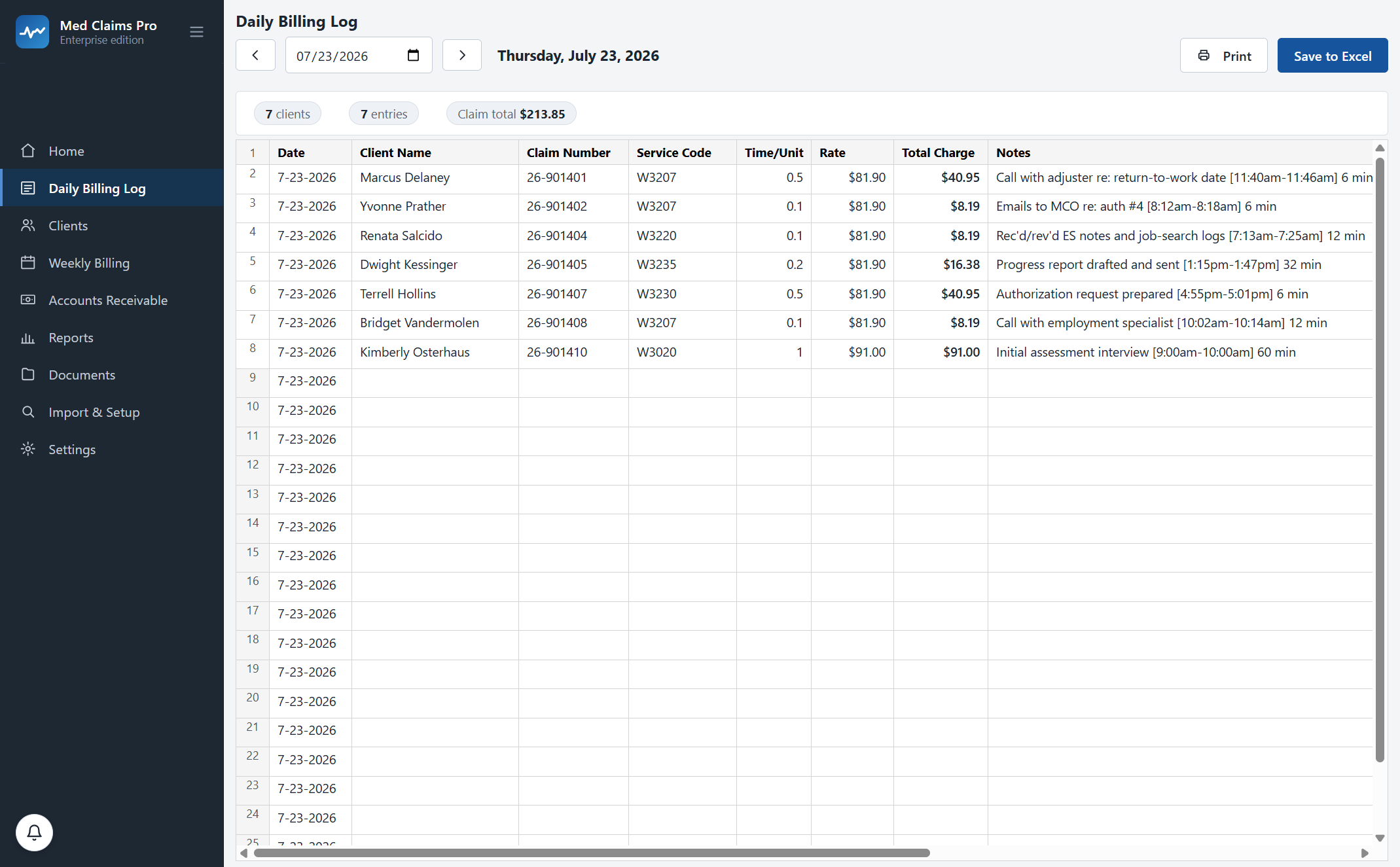
- 1:15 p.m.Employer contact, then a written update to the adjuster.Two rows. The narrative is written once and reused in the monthly report.
- 4:30 p.m.Month end. Nine files, five payers, five itemized time bills.Every line dated, coded, timed and priced — and each bill becomes a receivable the moment it leaves.
Every one of those rows is typed once, as it happens. The daily log writes itself as you go, the weekly narrative log builds in your own Word template, a CMS-1500 fills with the right units and the right payer block where a payer wants one — and where your state bills on its own form or an invoice, the dated, timed, priced lines that go on it come off the grid, and the receivable is tracked from the moment the bill leaves. The whole chain →
The 2025 SBWC rehabilitation fee schedule.
| What you bill | Rate |
|---|---|
| Registered rehabilitation supplier | $106/hr |
| Catastrophic supplier | $124/hr |
Current as of July 2026 — verify with the Georgia State Board of Workers' Compensation (SBWC).
Catastrophic suppliers are board-certified separately; the higher rate follows the designation on the file, not the task.
Rates move. When they do it arrives as a data update, and every activity you already billed keeps the rate it was billed under — which is the only way a rate change survives an audit.
Georgia is one of three states where nurse case managers register too.
Rule 200.2 requires registration for non-catastrophic medical case managers, which puts Georgia alongside North Carolina’s NCIC registry and Maryland’s practitioner registration — three jurisdictions where the vocational supplier and the nurse case manager are governed from the same shelf.
That matters commercially: a Georgia practice that carries both kinds of file needs one system that produces a six-minute-unit time bill and an hourly case-management invoice from the same activity grid. It does. The nurse case manager workflow.
The Board keeps a public supplier roster, which is also how adjusters check you before they assign. Being findable is not the same as being easy to pay — the itemization is what makes you easy to pay.
Who pays you in Georgia.
No state fund here. You bill private carriers, TPAs and self-insured employers directly, which means the submission address changes per payer and the thirty-day expectation is yours to enforce.
Georgia payers
- Private carriers
- TPAs
- Self-insured employers
National carriers you will meet
- Travelers
- The Hartford
- AmTrust
- Zurich
- Chubb
- Berkshire Hathaway
- Liberty Mutual
- AF Group / Accident Fund
- Old Republic
- Great American
TPAs that send the referrals
- Sedgwick
- Gallagher Bassett
- ESIS
- Helmsman
- Broadspire
- CorVel
- TRISTAR
- CCMSI
- Athens Administrators
One check, many claimants. Whichever of these names is on the envelope, the check covers a dozen files at once. You record it once, tick the bills it pays, and anything short is flagged with the exact gap and the original form attached, ready to rebill. How that screen works.
Billing addresses and submission preferences go stale faster than any page can keep up, so we publish them only where we keep them current — today that is Ohio’s nine MCOs. Your Georgia payers and their submission preferences get set up during onboarding, from your own files.
Where the rules actually live.
Straight from the source
Outbound links to the Georgia State Board of Workers' Compensation (SBWC). We do not mirror agency documents — the agency’s copy is the one that counts.
How we keep this page honest
Every fact above is transcribed from the Georgia State Board of Workers' Compensation (SBWC) or the statute named, dated July 2026, and reviewed when the agency republishes. Where we have not verified something we say so rather than filling the gap.
Found something out of date? Tell us and we will fix it the same week: (302) 202-3172 or admin@onservice.us.
See a Georgia caseload run itself.
Fifteen minutes, Georgia’s codes on screen, with a caseload that looks like yours. Or start the trial and poke around on your own — no card, no contract.
There is a phone number and a person answers it: (302) 202-3172.
States that work like Georgia
Questions, answered.
Does it handle catastrophic and non-catastrophic rates on one caseload?
Yes. The rate follows the file’s designation, so a catastrophic case bills at $124 an hour and a registered supplier file at $106 without you choosing per entry. Current as of July 2026 — verify with the Georgia SBWC.
What does the time bill actually look like?
Itemized: date, activity, minutes converted to six-minute units, rate, line total, with the narrative behind it. The format an adjuster can approve without a phone call, which is the difference between thirty days and ninety.
I do medical case management under Rule 200.2 as well.
Then you are one of the practices this was built for. The same activity grid produces a supplier time bill and an hourly case-management invoice, and the receivables list keeps both. More.
Do you know Georgia’s e-billing rules?
Not well enough to publish. We have not confirmed Georgia’s classification and will not guess at it. What we do ship is the bill, the documentation and filed proof of what was sent; direct electronic submission is roadmap everywhere.
Will it match my templates?
Yes — templates, folders, payers and rates are configured during onboarding, in your first week, included in every plan.
See your own week run itself.
We load your state’s codes before the call, so you are looking at a caseload like yours inside the first two minutes — not a slide deck.